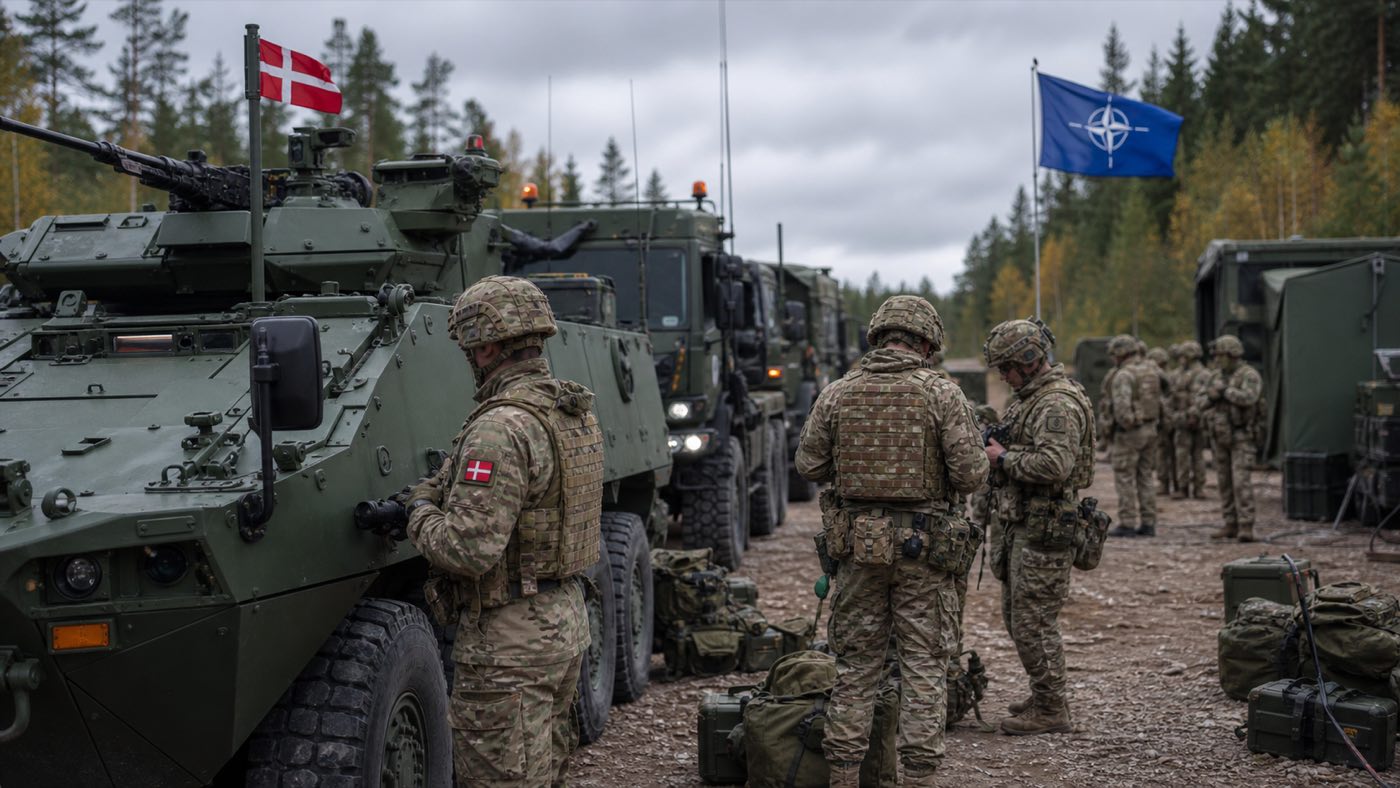
Denmark’s decision to deploy an 850-strong battalion to Latvia in the autumn is a concrete marker of how NATO’s Baltic reinforcement is moving from political commitment to planned force posture.
Reuters reported on 17 June that Denmark will send the battalion to Latvia, replacing a Swedish unit already deployed there. The move forms part of NATO’s wider effort to reinforce the Baltic states after Russia’s full-scale invasion of Ukraine transformed eastern-flank defence from reassurance into practical deterrence planning.
The significance is not the Danish announcement alone. It is the rotation model. Denmark is not promising abstract support or issuing a summit declaration. It is preparing to put a battalion-sized force on the ground in Latvia, within a multinational framework that has increasingly become central to NATO’s defence of the Baltic region.
Latvia hosts a Canada-led NATO force that began as part of the Alliance’s enhanced Forward Presence after the 2016 Warsaw summit. Since then, Russia’s war against Ukraine has changed both the scale and urgency of NATO’s posture in the region.
The Latvian Defence Ministry says the multinational force has been expanding from battlegroup to brigade level, with Canada as framework nation. Its account of the NATO Multinational Brigade in Latvia notes that Denmark joined the brigade in 2024, Sweden’s parliament approved long-term participation in 2024, and Swedish and Danish units are deployed on a rotational basis.
That matters because rotations create predictability. A one-off deployment signals political support. A scheduled handover from a Swedish unit to a Danish battalion suggests a more durable pattern: European allies are beginning to share the burden of keeping combat-capable forces close to Russia’s border.
Latvia’s strategic position gives such deployments significance beyond the number of troops involved. It borders Russia and Belarus, sits in the Baltic security space and forms part of the region NATO would have to reinforce rapidly in any crisis.
The Baltic states have limited strategic depth. In a conflict, NATO would need forces already present, command structures already tested, infrastructure already prepared and reinforcements able to arrive quickly. That is why the difference between a paper plan and a battalion in place is important.
An 850-strong Danish battalion will not by itself transform the military balance in the Baltic. But deterrence in the region is built through multinational presence, readiness and integration. Any attack on Latvia would immediately involve not only Latvian forces, but also troops from several NATO allies. That is the political and military logic of the forward-presence model.
The deployment also fits a broader European pattern. Germany is building a permanent brigade presence in Lithuania. Canada is expanding its role in Latvia. Sweden, now a NATO member, has joined Baltic rotations. Denmark’s autumn deployment adds another northern European ally to the practical reinforcement cycle.
This matters because US force posture is becoming less predictable. European allies are under growing pressure to demonstrate that eastern-flank deterrence does not depend solely on Washington. That does not mean the United States is irrelevant. It means European NATO members must provide more of the visible, usable military mass that makes deterrence credible day to day.
Denmark’s role is particularly relevant because it connects Baltic defence to the wider Nordic-Baltic security space. With Finland and Sweden inside NATO, northern European defence planning is no longer divided between alliance and non-aligned states. Danish, Swedish, Finnish, Baltic and Polish security concerns now sit inside the same NATO framework.
The Danish battalion should therefore be understood as a measure of deterrence becoming routine. NATO’s eastern-flank posture is no longer only about emergency reinforcement plans. It is about who deploys, when, with what equipment, under which command structure and how smoothly one ally can replace another.
That is less dramatic than a summit pledge, but more important operationally. Rotation schedules test transport, logistics, accommodation, maintenance, training ranges, interoperability and host-nation support. They also reveal whether European allies can sustain a presence without exhausting their own forces.
Defence Matters has recently examined how NATO’s rear areas can no longer be treated as safe assumptions. The Latvia deployment fits the same lesson. Baltic deterrence depends not only on frontline units, but on the ability to move, supply and rotate those units through vulnerable European infrastructure.
For Moscow, the message is that NATO’s Baltic posture is becoming more institutionalised. For Latvia, it means another allied unit will be present as part of a regular reinforcement cycle. For Denmark, it is a test of whether national forces can contribute meaningfully to a sustained eastern-flank mission while also meeting other NATO demands.
The deployment is not a complete answer to Baltic defence. The region still needs air defence, logistics depth, counter-drone capability, ammunition stocks and rapid reinforcement routes. But battalion rotations are one of the practical building blocks on which those larger plans depend.
Denmark’s autumn move therefore deserves attention precisely because it is concrete. It turns NATO’s Baltic reinforcement from a general promise into soldiers, equipment, timelines and handover arrangements on Latvian ground.