Yet as we move into 2026, Japan is quietly but decisively recasting itself — not as an aggressor, but as one of the most reliable and capable providers of security in the Indo-Pacific.
The country’s gradual shift from exclusive self-defence towards a more muscular military posture is now unmistakable. Far from a sudden break with the past, it represents a sober response to the realities of a region increasingly shaped by coercion, grey-zone tactics and strategic uncertainty. Tokyo’s message is clear: peace in the Pacific can no longer be sustained by hope alone; it requires credible strength, shared responsibility and dependable allies.
At the centre of this transformation is a record defence budget, now exceeding ¥9 trillion, which underwrites a programme focused not on conquest but on deterrence, resilience and regional stability. Japan’s Self-Defense Forces are acquiring longer-range strike capabilities, advanced missile defence systems, and a growing fleet of unmanned platforms designed to patrol vast maritime spaces. These investments are explicitly framed as tools to prevent conflict, not provoke it.
What marks this moment as historically significant, however, is Japan’s willingness to move beyond national defence and actively support the security of others. In policy and practice, Tokyo is positioning itself as a stabilising force across the Pacific — from the East China Sea to the South Pacific islands — shouldering responsibilities once borne almost entirely by the United States.
This is most evident in Japan’s deepening network of security partnerships. Long the cornerstone of American strategy in Asia, Japan is now increasingly indispensable to it. Joint exercises with US forces have grown in scale and sophistication, while new operational arrangements allow Japan to provide logistical support, intelligence and base access to allied militaries operating in the region. The result is a far more integrated and credible deterrent posture.
Beyond Washington, Japan’s reach is expanding rapidly. Defence cooperation agreements with Australia, the Philippines and several Southeast Asian nations reflect a shared concern over maritime security and freedom of navigation. Japanese patrol vessels, radar systems and training programmes are already strengthening the capabilities of regional partners, particularly those facing pressure in contested waters.
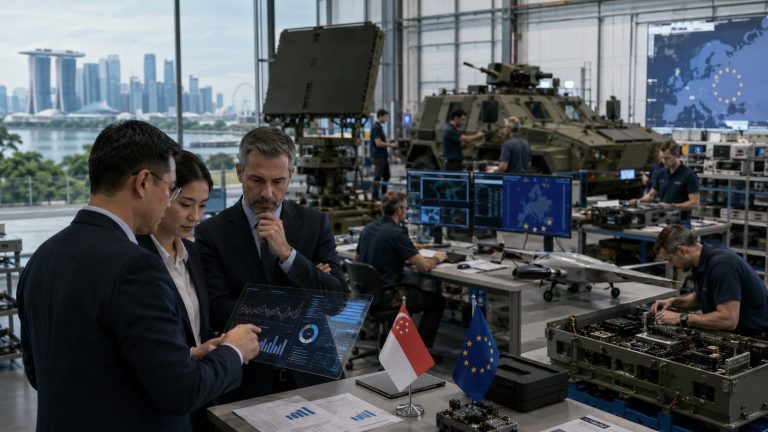
Crucially, Tokyo is no longer content merely to import security. The easing of arms export restrictions has transformed Japan into a trusted supplier of high-end defence equipment, from radar systems to naval platforms. Joint development programmes — including next-generation fighter aircraft with Britain and Italy — underline Japan’s emergence as a serious defence industrial power, capable of shaping, not just buying, the tools of future warfare.
This outward-facing posture has been welcomed quietly but warmly across much of the Pacific. Smaller states, wary of being caught between rival powers, increasingly see Japan as a reassuring presence: technologically advanced, politically stable and historically cautious in its use of force. Unlike other regional powers, Japan’s influence rests not on intimidation but on reliability.
Critics, particularly in Beijing, have accused Tokyo of abandoning its pacifist principles. Yet such claims sit uneasily with the facts. Japan remains firmly committed to its non-nuclear stance, democratic oversight of military power and alliance-based decision-making. Its doctrine is defensive in spirit, but collective in outlook — recognising that the security of the Pacific is indivisible.
At home, the shift has prompted serious debate, as it should. Pacifist traditions remain deeply rooted, shaped by the memories of Hiroshima and Nagasaki. But there is also growing public recognition that passivity carries risks of its own. In an era of missile tests, maritime harassment and cyber attacks, many Japanese voters now accept that contributing more to regional security is both prudent and morally responsible.
Indeed, Japan’s evolution may prove one of the most consequential strategic developments in the Pacific this decade. A nation once defined by military absence is becoming a cornerstone of deterrence, anchoring an alliance system designed to preserve peace through strength and cooperation.
As Japan enters 2026, it does so not in defiance of its past, but in defence of the order that allowed it to prosper. By stepping forward as a provider of security — measured, disciplined and allied — Japan is helping to ensure that the Pacific remains governed by rules, not force. In doing so, it is no longer merely reacting to the region’s future, but helping to shape it.
Main Image: U.S. Navy photo by Chief Photographer’s Mate Todd Cichonowicz Public Domain, https://commons.wikimedia.org/w/index.php?curid=8221818
Japan Is Right to Prepare for Military Action if China Strikes Taiwan