Oslo plans to maintain support at NOK85 billion in 2027, with most funding again intended for military purposes, while a new bilateral framework links Ukrainian battlefield technology to Norwegian capital, research and manufacturing capacity.
The funding proposal announced by Prime Minister Jonas Gahr Støre would maintain the same headline level as 2026 through the Nansen Support Programme. Most of the money is again expected to support military requirements, including procurement from Ukrainian defence companies, although Oslo has not yet fixed the military and civilian shares.
The NOK85 billion is not a completed appropriation. It will be placed before the Storting as part of the 2027 budget process. Norway’s parties have previously given the Nansen programme broad parliamentary support, but the constitutional spending decision still belongs to parliament.
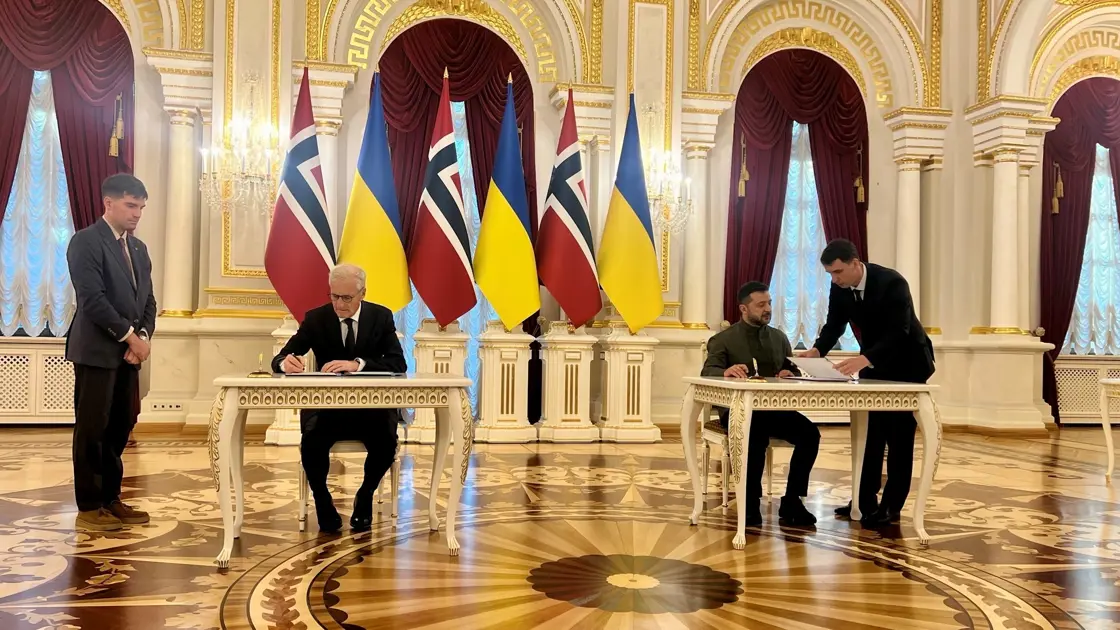
The announcement coincided with a strategic partnership and defence agreement signed in Kyiv. The defence component sits within the “Drone Deal” model, which Norway describes as a framework for long-term co-operation between Ukraine and partner countries based on operational experience, technology exchange and joint identification of capability needs.
That combination is more consequential than a routine aid renewal. Predictable funding gives Ukraine greater visibility over future demand, while the bilateral framework creates a route through which Norwegian institutions and companies can work with Ukrainian developers on drones, air defence, research, supply chains and other projects.
No specific contract has yet been awarded under the new agreement. The model is deliberately phased: the parties identify needs and possible areas of co-operation before prioritising projects and concluding implementing arrangements. The signature therefore creates a mechanism, not an inventory of weapons already ordered.
For Ukraine, the industrial value lies in demand certainty and access to finance. Many Ukrainian defence businesses can move from battlefield feedback to new designs much faster than traditional procurement systems, but they still face constraints in working capital, secure production sites, components and long-term orders. Norwegian funding can help convert promising prototypes and small production runs into repeatable output.
Purchasing directly from Ukrainian industry can also shorten the distance between the user and the manufacturer. A drone or electronic-warfare system can be modified in response to Russian countermeasures and returned to the front more rapidly when the engineering team is closely connected to operating units.
The benefit is not one-way. Norway gains access to operational knowledge generated in a conflict where unmanned systems, electronic warfare, distributed production and rapid software iteration are changing continuously. Its companies and armed forces can use that experience to refine their own requirements, test whether systems survive contested conditions and identify weaknesses in European supply chains.
The agreement’s references to air defence and drones also point towards combinations of capabilities rather than a narrow focus on airframes. Effective unmanned operations require sensors, communications, navigation resilient to jamming, data processing, munitions, trained operators and a supply system able to replace losses. Counter-drone defence creates a parallel demand for detection, electronic attack and inexpensive interceptors.
Norway is simultaneously expanding its national forces. Defence Matters recently reported on the creation of an artillery battalion for the Finnmark Brigade on the Russian frontier. The Ukraine partnership is a different strand of the same security response: one builds Norwegian formations at home, while the other supports Ukraine and feeds combat lessons into Norwegian capability development.
There are risks. Urgent wartime procurement can create pressure on quality assurance, intellectual-property terms and export controls. Joint projects must decide where production takes place, which party owns improvements and how sensitive operational data are protected. Norwegian industry will also need to avoid slowing Ukrainian development with peacetime approval cycles.
The 2027 proposal gives the framework financial credibility, but the decisive information will come later: the Storting’s appropriation, the military/civilian split, the value directed to Ukrainian manufacturers and the first named industrial projects.
Until then, Norway has established direction rather than delivered output. It is signalling that support will extend beyond annual transfers and towards a defence relationship in which Ukrainian technology and Norwegian resources are intended to strengthen both countries’ forces.