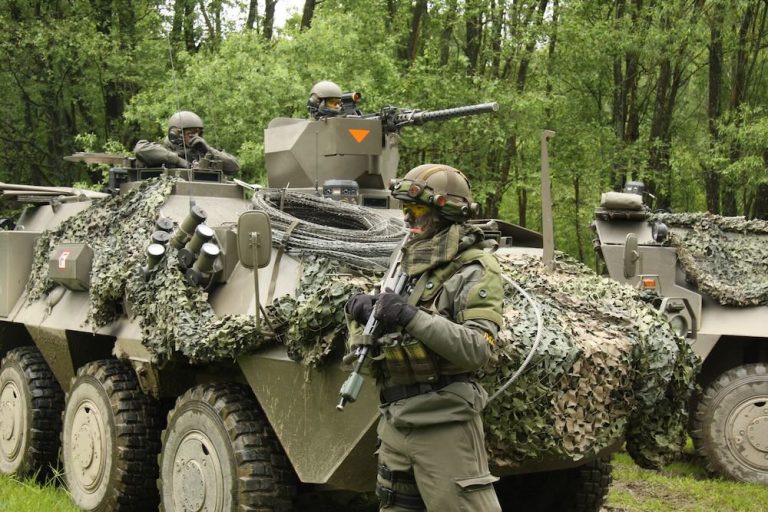
The Pentagon has formally begun a review of the United States’ military posture in Europe, opening a process that could alter the number, composition and location of American forces across the continent.
Elbridge Colby, the Pentagon’s under-secretary for policy, said the assessment was intended to ensure that NATO moved “fast and irreversibly” towards Europe assuming primary responsibility for its conventional defence. General Alexus Grynkewich, commander of US European Command and NATO’s Supreme Allied Commander Europe, will help coordinate the review with senior Pentagon officials.
The review will take up to six months and produce a range of options based on current military and geopolitical conditions. Colby said Washington would consult European allies and the US Congress, but the Pentagon has not specified how many troops might be withdrawn, which units could be affected or whether forces would be moved between European countries rather than returned to the United States.
US Defence Secretary Pete Hegseth announced the assessment during a meeting of NATO defence ministers in Brussels on 18 June. He described it as part of a transition towards “NATO 3.0”, under which European members would carry the main burden of conventional deterrence while the United States retained its nuclear role and selected high-end capabilities. Hegseth warned that some countries would fail the review while others would pass “with flying colours”.
Around 80,000 American military personnel are currently stationed in Europe. That figure, however, does not fully describe the operational importance of the US presence. American forces provide command-and-control infrastructure, intelligence and surveillance, air-to-air refuelling, strategic airlift, integrated air and missile defence, logistics, long-range fires and access to stockpiled equipment.
The review will therefore be judged less by the total number of personnel removed than by the capabilities that remain. The departure of a support formation can have wider consequences than the withdrawal of a larger combat unit if it reduces NATO’s ability to move forces, identify targets, sustain air operations or coordinate multinational formations.
European bases also serve purposes beyond the defence of Europe. US European Command identifies the protection of the American homeland, the projection of US combat power and the positioning of NATO to deter attack as its central missions. Facilities in Europe support American operations extending into Africa and the Middle East, making the European posture an instrument of US global reach as well as a contribution to NATO.
Washington has already begun making adjustments. A planned American rotation through Eastern Europe was cancelled, while approximately 1,000 troops reportedly left Lithuania without replacement. Earlier reductions and proposed changes to NATO rapid-response commitments have added to concern that the current review may formalise a broader transfer of responsibility.
European defence expenditure is rising rapidly. The EU’s 27 members spent €418 billion in 2025, an increase of 20 per cent from the previous year, and the European Defence Agency expects the figure to reach €454 billion in 2026. Higher budgets are strengthening procurement, ammunition production and force readiness, but expenditure cannot immediately replace capabilities accumulated through decades of American investment.
NATO Secretary-General Mark Rutte has acknowledged that the alliance requires greater clarity about which American forces would be available during simultaneous crises in Europe and the Indo-Pacific. He argued that a more realistic NATO force model could ultimately produce more resilient defence plans, provided changes were coordinated with allies.
Sequencing will be decisive. A gradual transfer accompanied by European procurement, expanded production and revised NATO plans could strengthen the European pillar of the alliance. Removing capabilities before replacements are operational would instead create temporary vulnerabilities, particularly in air defence, intelligence, logistics and long-range strike.
The review will also affect Ukraine. Although the Pentagon has presented it as an assessment of NATO’s wider force posture, any reduction in American capabilities near the alliance’s eastern flank would influence European planning, reinforcement routes and calculations about Russia’s ability to test NATO cohesion.
The launch of the review does not mean that a large withdrawal has already been decided. It does confirm that Washington now regards the existing division of responsibilities as unsustainable. “NATO 3.0” has consequently moved beyond political rhetoric. It is becoming a military planning process whose outcome will depend on what Europe can field, how quickly it can field it and whether American reductions are coordinated with those preparations.