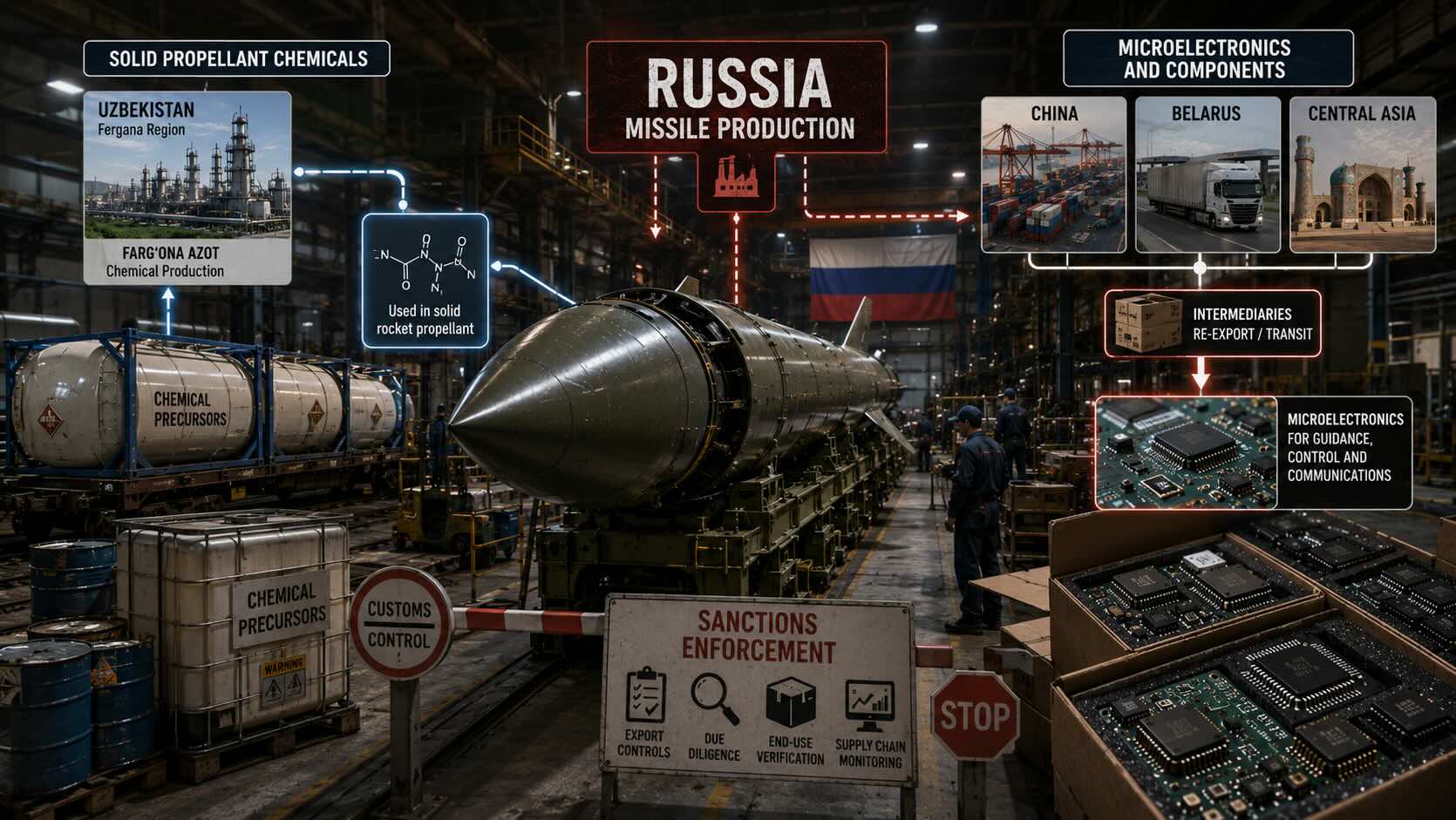
Russia’s ability to manufacture ballistic and cruise missiles rests partly on supply chains extending beyond its borders. Two areas present possible points of pressure: chemicals that may be suitable for producing solid rocket propellant and imported microelectronics used in guidance, communications and control systems.
The dependence on foreign electronic components is established. Ukraine’s military intelligence maintains an open database of foreign-produced parts recovered from Russian weapons, covering thousands of components identified in missiles, drones and other military systems. The database includes semiconductors, processors, converters, memory devices and communications equipment made by companies in the United States, Europe and Asia.
Research into Russian procurement networks has likewise found that components manufactured by Western companies continued to enter the country after February 2022. An analysis of Russian customs records identified more than 200,000 shipments of restricted microelectronics between 2022 and January 2024. Components made by several American manufacturers were subsequently identified in systems including Kh-101, Iskander, Kinzhal and Kalibr missiles.
The manufacturers generally say that they stopped authorised sales to Russia and require distributors to comply with export restrictions. The principal enforcement problem is therefore not necessarily direct trade, but re-export through intermediaries, distributors and companies established in jurisdictions that have not adopted equivalent sanctions.
The European Union has extended controls on dual-use goods and advanced technology, including electronics, sensors, navigation equipment and machinery that could support Russia’s military-industrial complex. Subsequent sanctions packages have also targeted foreign entities accused of supplying Russia or facilitating circumvention.
Nevertheless, the continued recovery of recently manufactured foreign components from Russian weapons indicates that the controls remain incomplete. Components can pass through several companies and countries before reaching a Russian defence contractor, making it difficult for the original producer to identify the ultimate customer.
Closer tracking by serial number, production batch and distributor could improve enforcement. Governments could require manufacturers of priority dual-use products to retain more detailed records, identify unusual orders and investigate sudden increases in sales to countries adjoining Russia. Financial institutions, freight companies and customs authorities could then compare transaction data against known procurement patterns.
A second potential vulnerability concerns chemicals used in solid-propellant production. The material provided for this analysis alleges that relevant chemicals are being supplied from Uzbekistan and identifies the Fergana-based producer Farg‘onaazot. That allegation should not be treated as established without customs records, contracts or evidence connecting particular products to Russian missile manufacturers.
The underlying corporate details are verifiable. Uzbekistan agreed in January 2023 to sell a 99.02 per cent state holding in Farg‘onaazot to Singapore-based Indorama Corporation. The agreed price was $140 million, accompanied by a commitment to invest in modernisation. Indorama subsequently confirmed that it had completed the acquisition in November 2023.
Farg‘onaazot produces fertilisers and industrial chemicals. That alone does not demonstrate involvement in Russia’s weapons programme: many chemical products and their precursors have legitimate agricultural and industrial applications. Establishing a military connection would require identifying the substance involved, its buyer, the intermediary companies, the declared destination and its ultimate end-user.
The appropriate response would therefore be an official supply-chain investigation rather than an assumption of corporate responsibility. European, British, American and Ukrainian authorities could examine whether controlled chemicals or materials suitable for propellant production have been exported from Uzbekistan to Russian entities, directly or through third countries. Indorama could also be asked to disclose its end-user controls and procedures for screening sales from the Farg‘onaazot operation.
The strategic logic is straightforward. Every missile prevented from entering production reduces pressure on Ukraine’s limited stock of air-defence interceptors. The EU has already restricted products used in preparing propellants, demonstrating that chemical inputs are recognised as part of the sanctions problem. The remaining task is to identify where those materials originate and how they reach Russian manufacturers.
Pressure on supply chains may also be more economical than relying exclusively on interception. Air-defence missiles are expensive, production capacity is constrained and no system provides complete protection. Export controls cannot replace Patriot or other air-defence systems, but effective controls can limit the number and technical quality of the weapons those systems must confront.
The wider argument extends to Russia’s war economy. Ukrainian long-range strikes have increasingly targeted refineries, storage facilities and export infrastructure that provide revenue or logistical support for the war. Novorossiysk is particularly sensitive because it handles Russian exports while also serving the Caspian Pipeline Consortium, which transports predominantly Kazakh crude from the Tengiz field to the Black Sea. Chevron confirms that the 1,511-kilometre pipeline terminates at Novorossiysk and carries oil in which the company and its partners have commercial interests.
That mixed use makes the terminal strategically important but politically and legally complicated. Disruption could affect Russia’s export revenues, but it could also damage Kazakhstan’s access to international markets and the interests of Western energy companies.
Supply-chain enforcement offers a more targeted course. Rather than waiting until completed missiles are launched, governments can identify the chemicals, electronics, machine tools, financial services and transport routes needed to manufacture them. Russia has shown that it can adapt to sanctions, but adaptation carries costs and creates dependence on a narrower group of suppliers and intermediaries.
The central question is no longer whether foreign inputs remain present in Russian weapons. In the case of microelectronics, the evidence is extensive. The question is whether governments are prepared to trace individual transactions, penalise repeat intermediaries and require multinational companies to investigate where sensitive products ultimately go.