

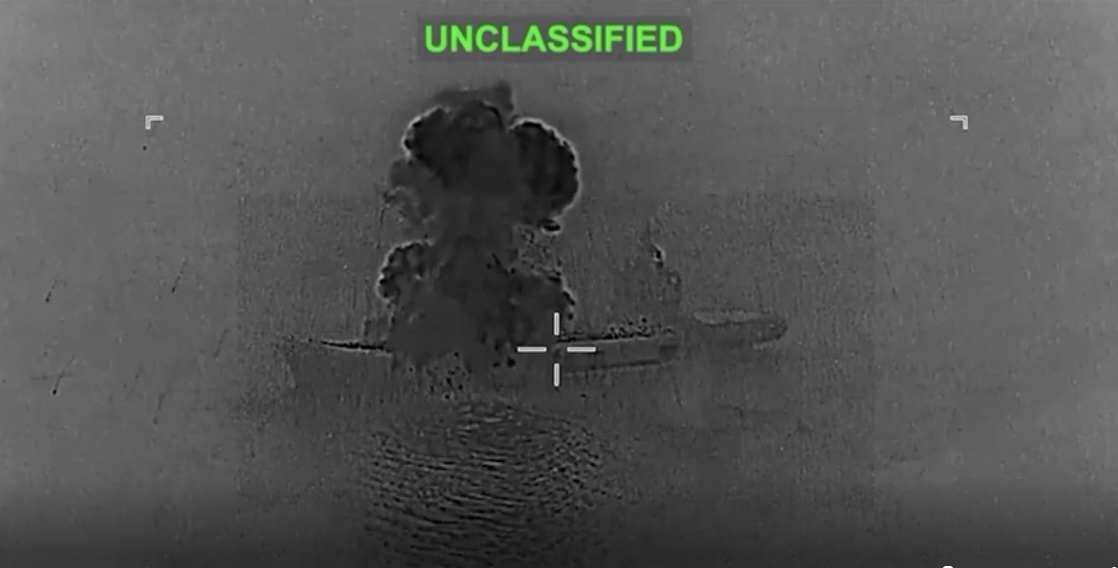
One of the most prominent reported losses for Tehran was the Shahid Bagheri, an Iranian drone carrier operated by the naval arm of the Islamic Revolutionary Guard Corps. US Central Command chief Admiral Brad Cooper said American forces had struck the vessel and that it was burning, while Associated Press reported that the ship had been set ablaze at sea as part of a broader campaign against Iran’s naval assets.
The Shahid Bagheri had been presented by Iran as a symbol of its effort to extend military reach beyond its immediate coastline. The vessel entered service in February 2025 and had been converted from a commercial container ship into a platform for unmanned aircraft and helicopters, with a flight deck of about 180 metres.
Washington says the strikes form part of a broader effort to dismantle Iran’s offensive military capability. Reuters reported on Thursday that US Defence Secretary Pete Hegseth insisted the United States was not expanding its war aims, saying the campaign remained focused on degrading Iran’s missile forces, production infrastructure, naval power and nuclear-related capabilities. In the same report, Admiral Cooper said more than 2,000 targets had been hit since the operation began, including 30 warships and the drone carrier.
There were also fresh attacks on targets inside Iran’s capital. AP reported that Israeli air strikes hit Tehran heavily early on Friday, with witnesses describing particularly intense bombardment in the eastern part of the city. Separate reports said strikes had also hit state, security and military-linked facilities, reflecting a widening target set beyond Iran’s missile launch sites and air-defence network.
According to Reuters, US officials now say Iranian retaliatory capability has been significantly reduced. Hegseth said Iranian attacks had not ceased, but American commanders claimed that missile launches had fallen sharply and that a large part of Iran’s navy had been destroyed or disabled. Those battlefield claims remain difficult to verify independently in full, but they are consistent with reporting from AP and other outlets that Iran’s air-defence and missile infrastructure has suffered severe damage in less than a week of war.
Israeli and American officials appear to be moving into what they describe as a second phase of the campaign: not only suppressing immediate launch capability, but striking the industrial and logistical base that allows Iran to rebuild. US officials identified missile production and support infrastructure as key targets, while deeply buried sites were also being attacked with heavy munitions.
Iran, however, has continued to respond. Tehran launched new retaliatory missile and drone attacks across the region, targeting not only Israel but also Arab states hosting US military forces. The fighting has therefore widened beyond a bilateral confrontation and now poses a direct threat to regional infrastructure, energy flows and commercial aviation. The shipping through the Strait of Hormuz has been severely disrupted, with maritime traffic sharply reduced.
The political implications are becoming as important as the military ones. Reuters noted that President Donald Trump suggested the conflict could shape Iran’s future political leadership, even as Hegseth tried to keep the stated mission limited to military objectives. That gap between operational goals and political rhetoric may become more significant if the Iranian state structure weakens further.
For now, the immediate picture is one of rapid military erosion rather than collapse conclusively established. Iran has lost high-value naval assets, key missile infrastructure and portions of its command network, while Tehran itself is under direct and repeated attack. Yet the regime retains the capacity to strike back, and the war is clearly entering a more dangerous stage in which military gains, political uncertainty and regional escalation are unfolding at the same time.


Britain’s Consistent Message on Ukraine Carries Growing Weight at the OSCE