What was once unthinkable—women in infantry units, armoured corps, even special forces—has become, if not commonplace, then at least unremarkable in many European capitals. Yet the picture remains uneven, marked by cultural hesitations, legal asymmetries and a persistent gap between policy and practice.
At the broadest level, the trend is unmistakable. Across NATO and the European Union, women now comprise a growing share of uniformed personnel—around 13.9 per cent in NATO forces as of 2024, up from just over 10 per cent a decade earlier. This is no mere statistical curiosity; it reflects a conscious shift in doctrine. Modern European militaries, confronted by demographic decline and increasingly technical warfare, have recognised that excluding half the population is an unaffordable luxury.
Yet integration into combat roles—the sharp end of soldiering—has been slower and more contentious.
A cluster of northern and western European states has led the charge. Countries such as Norway, Sweden, Finland and Denmark have not only opened combat roles to women but, in some cases, have extended conscription on equal terms. Norway stands as the most emblematic case: it was the first NATO country to allow women in all combat capacities and later to introduce gender-neutral conscription. Sweden and Denmark have followed similar paths, embedding gender equality within the very structure of military obligation.
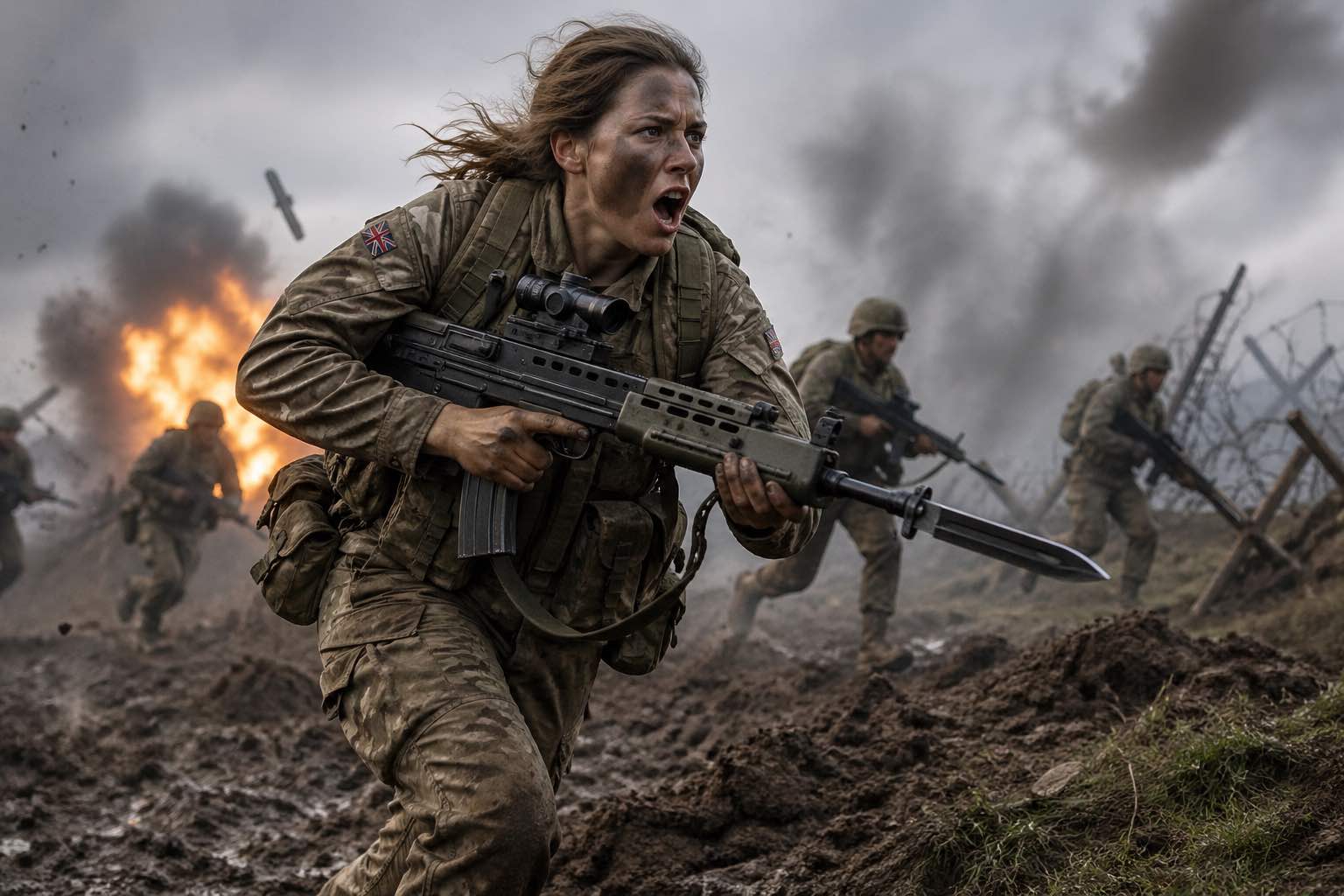
Elsewhere, large Western European powers have moved decisively, if later. The United Kingdom completed the process in 2018, opening all roles—including infantry and special forces—to women. France and Germany have likewise dismantled most formal barriers; in Germany, a landmark European Court of Justice ruling in 2001 forced the Bundeswehr to admit women to combat units, ending decades of restriction.
In Central and Eastern Europe, progress has been uneven but tangible. Poland has permitted women in all military roles since 1999, while the Baltic states—Estonia and Lithuania among them—are counted among those allowing women in front-line combat positions.
Yet even within the European Union, full integration remains far from universal. Only around eleven member states currently allow women in front-line combat roles without restriction, including Denmark, Finland, France, Germany, Ireland, the Netherlands, Poland, Romania and Sweden. That leaves a significant number where women are either formally excluded from certain combat functions or effectively discouraged by policy and practice.
Southern European militaries, in particular, have often lagged behind. While Italy and Spain have expanded opportunities for women, cultural conservatism and institutional inertia have sometimes limited their presence in elite combat units. In other cases, legal barriers may have fallen, but informal ones—ranging from recruitment practices to physical standards—continue to shape outcomes.
If legislation were the sole measure, one might conclude that the question has been settled. In practice, however, integration has proved more complex.
The first challenge is numerical. Even in countries that have fully opened combat roles, women remain underrepresented in front-line units. Across the European Union, women constitute roughly 10 per cent of military personnel on average, with only a handful of countries—such as Sweden and Finland—approaching or exceeding 20 per cent. Combat arms, with their demanding physical and cultural environments, tend to attract fewer women still.
The second challenge is institutional culture. Reports across European forces point to persistent issues: gender stereotypes, limited career progression, and difficulties in retention. The military, by its nature, is a conservative institution, and while policy can change swiftly, culture seldom does.
Then there is the question of standards. Critics of integration have often argued that the inclusion of women risks a dilution of physical requirements. Proponents counter that standards should be role-specific and gender-neutral, applied equally to all who seek to serve. In most European militaries, the latter view has prevailed, at least in principle. The British Army’s approach—opening all roles while maintaining uniform standards—is typical of the modern orthodoxy.
What, then, of the central question: have women in combat roles proved effective?
The available evidence suggests that, where given the opportunity, women have performed capably across a range of operational environments. In Afghanistan and Iraq, British female personnel served alongside infantry units, often in roles that placed them in direct combat, even before formal restrictions were lifted. Some were decorated for bravery; others paid the ultimate price.
Nordic militaries, frequently cited as exemplars, report broadly positive experiences. Female soldiers have served in infantry, artillery and even submarine crews, contributing to operational effectiveness without the disruption once feared. Norway’s experience, in particular, is often invoked to demonstrate that integration, when managed carefully, need not compromise cohesion.
Yet success has not been unqualified. Studies and internal reviews across NATO have highlighted challenges in mixed-gender units, including issues of cohesion, physical disparity and the management of small-unit dynamics under extreme stress. These are not insurmountable problems, but they require careful handling, particularly in elite combat formations where margins for error are narrow.
Moreover, the psychological and social dimensions of combat—long deployments, austere conditions, and the intimacy of life in small units—have raised questions about how best to integrate women without undermining effectiveness. Different countries have adopted different approaches, from strict enforcement of conduct rules to adjustments in accommodation and training.
Despite the general trend towards inclusion, there remain European militaries where women are excluded—either formally or effectively—from certain front-line roles.
In some cases, restrictions are explicit. Certain countries continue to bar women from infantry or special forces units, citing physical requirements or operational concerns. In others, the barriers are more subtle: women may be technically eligible for combat roles but face structural obstacles that limit their participation.
Turkey, for example—though not an EU member but a significant European military actor—has historically restricted women from serving in infantry, armour and submarine roles, even while allowing them to serve as officers in other branches. Such policies illustrate that the European picture is not uniform, particularly when one considers NATO as a whole.
Beyond questions of equality, there is a strategic rationale for integrating women into combat roles. European militaries face a looming manpower challenge, exacerbated by ageing populations and declining interest in military service. Expanding the recruitment pool is not merely desirable; it is essential.
There is also a growing recognition that modern warfare—particularly in areas such as cyber operations, intelligence and drone warfare—places a premium on skills that are not strictly physical. The battlefield itself is changing, and with it the attributes required of those who fight.
It would be premature to declare the experiment complete. The integration of women into combat roles in Europe remains, in many respects, a work in progress—uneven, occasionally contentious, but broadly advancing.
The balance of evidence suggests that fears of catastrophic disruption have not been borne out. Where women have been integrated thoughtfully, with clear standards and robust training, they have contributed effectively to military operations. At the same time, the challenges—cultural, institutional and operational—are real and demand continued attention.
In the end, the question may be less whether women can serve in combat than whether European militaries can afford not to let them. The answer, increasingly, appears self-evident.