

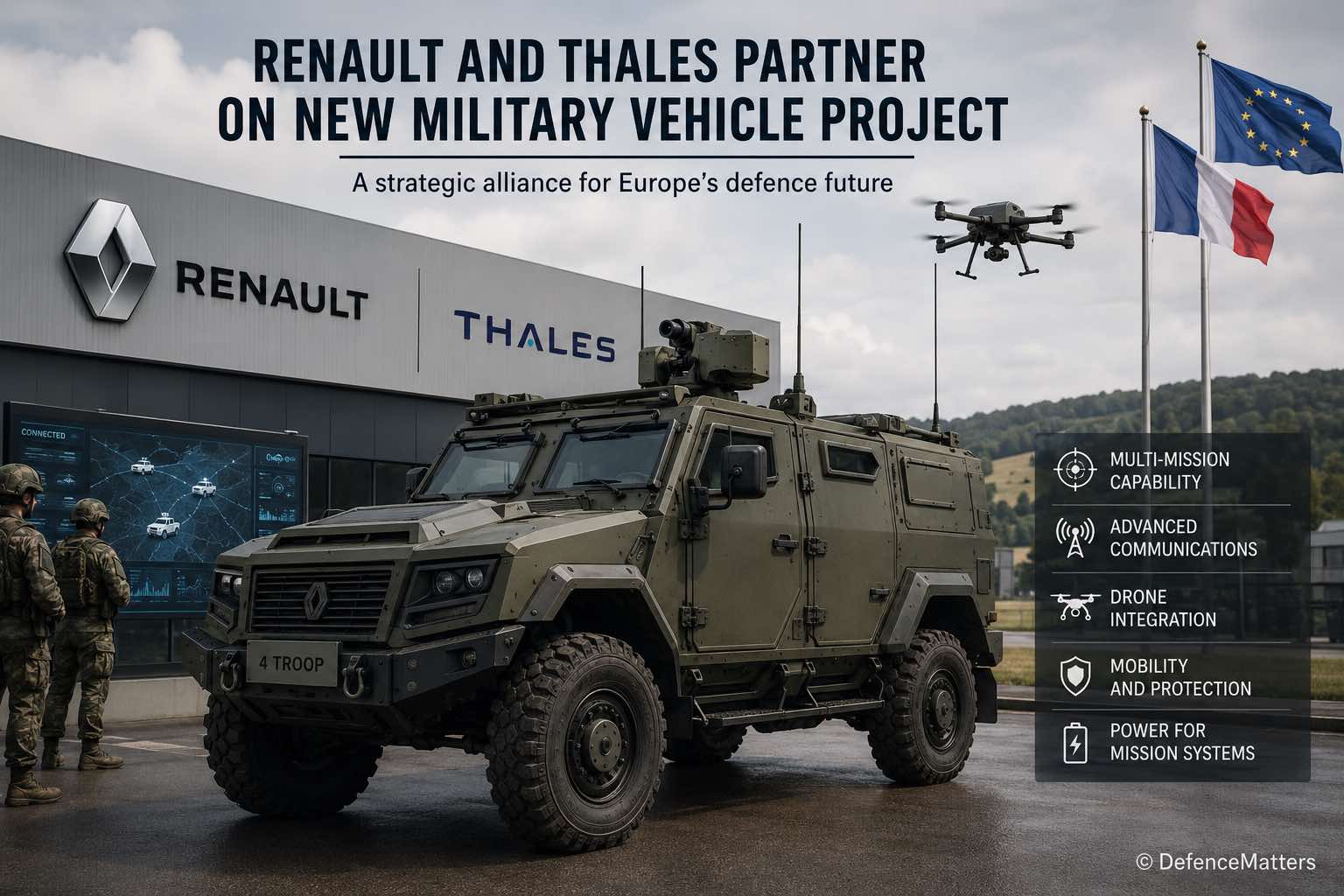
The project, unveiled at the Eurosatory defence exhibition near Paris, centres on a multi-mission tactical vehicle known as the 4 TROOP, designed to combine Renault’s expertise in large-scale industrial production with Thales‘ capabilities in secure communications and battlefield technologies. According to the companies, the platform is intended to be produced rapidly and at competitive cost, reflecting the changing priorities of European governments as they seek to replenish stockpiles and modernise armed forces.
The announcement would have been almost unthinkable a decade ago. European automotive groups were then focused overwhelmingly on electrification, emissions targets and the challenge posed by digital disruption. Today, the geopolitical backdrop has altered dramatically. Russia’s invasion of Ukraine, persistent instability along Europe’s eastern flank and renewed pressure from Washington for NATO allies to shoulder a greater share of defence spending have prompted a reassessment of industrial priorities.
For Renault, the partnership is the latest step in a carefully calibrated expansion into defence-related activities. The company has already explored drone production through collaborations with specialist defence groups and has indicated that it sees opportunities in applying civilian manufacturing techniques to military applications. Yet Renault has simultaneously sought to reassure investors that defence will remain a relatively modest contributor to revenues.
That balancing act reflects the sensitivity surrounding the sector. Carmakers have spent years promoting environmental credentials and social responsibility frameworks. A substantial move into arms manufacturing risks alienating some shareholders and consumers. Nevertheless, the distinction between civilian and military production is becoming increasingly blurred as governments encourage companies with advanced engineering capabilities to support national resilience.
The appeal for defence ministries is obvious. Traditional defence contractors often operate with lengthy development cycles and constrained production capacity. By contrast, automotive manufacturers have extensive supply chains, expertise in mass production and the ability to scale output rapidly.
Renault’s contribution to the venture is therefore less about reinventing military technology and more about industrial efficiency. Thales, meanwhile, provides the sophisticated communications and systems integration capabilities required for modern warfare. Increasingly, military vehicles are not merely transport platforms but mobile nodes within digital networks, expected to coordinate troops, process data and interact with unmanned systems.
The proposed vehicle reflects those changing operational realities. It has been conceived for a range of missions, including surveillance, troop coordination and the deployment of drones. The ability to supply power to external equipment through vehicle-based energy systems further illustrates how military requirements are evolving.
The broader significance extends beyond Renault itself. Across Europe, governments are attempting to expand defence industrial capacity after years of underinvestment. The challenge lies not only in allocating additional funding but also in ensuring that manufacturers can deliver equipment quickly enough to meet strategic needs.
France has positioned itself at the forefront of these efforts, advocating greater European strategic autonomy while encouraging domestic industry to support defence objectives. Partnerships such as the one between Renault and Thales fit neatly within that agenda, demonstrating how established industrial champions can be mobilised in support of national and continental security priorities.
Questions remain, however, about the commercial implications. Defence programmes can be lucrative, but they are also subject to political uncertainty, lengthy procurement processes and shifting operational requirements. Analysts are likely to view Renault’s initiative less as a transformational earnings opportunity and more as a strategic diversification exercise.
Even so, symbolism matters. The image of one of Europe’s best-known automotive brands helping to produce military equipment captures the profound changes underway across the continent’s economy. The post-Cold War assumption that defence was a specialised niche, largely separate from civilian industry, is giving way to a more integrated model in which industrial capacity itself is regarded as a strategic asset.
For Renault, the move represents adaptation to a changing world. For Europe, it may signal the emergence of a new industrial consensus — one in which economic competitiveness and national security are increasingly intertwined.
Thales Wins Key Role in Canada’s Next-Generation Naval Fleet


Britain’s Consistent Message on Ukraine Carries Growing Weight at the OSCE