

Britain’s decision to transfer the intellectual property behind Stone Cloak gives Ukraine more than another electronic-warfare device: it creates the basis for domestic manufacture, faster battlefield adaptation and a more reciprocal defence-industrial partnership.
Britain is to hand Ukraine the intellectual property behind the Stone Cloak electronic-warfare system, allowing Ukrainian industry to manufacture at scale a device that British officials say has already been supplied in its thousands.
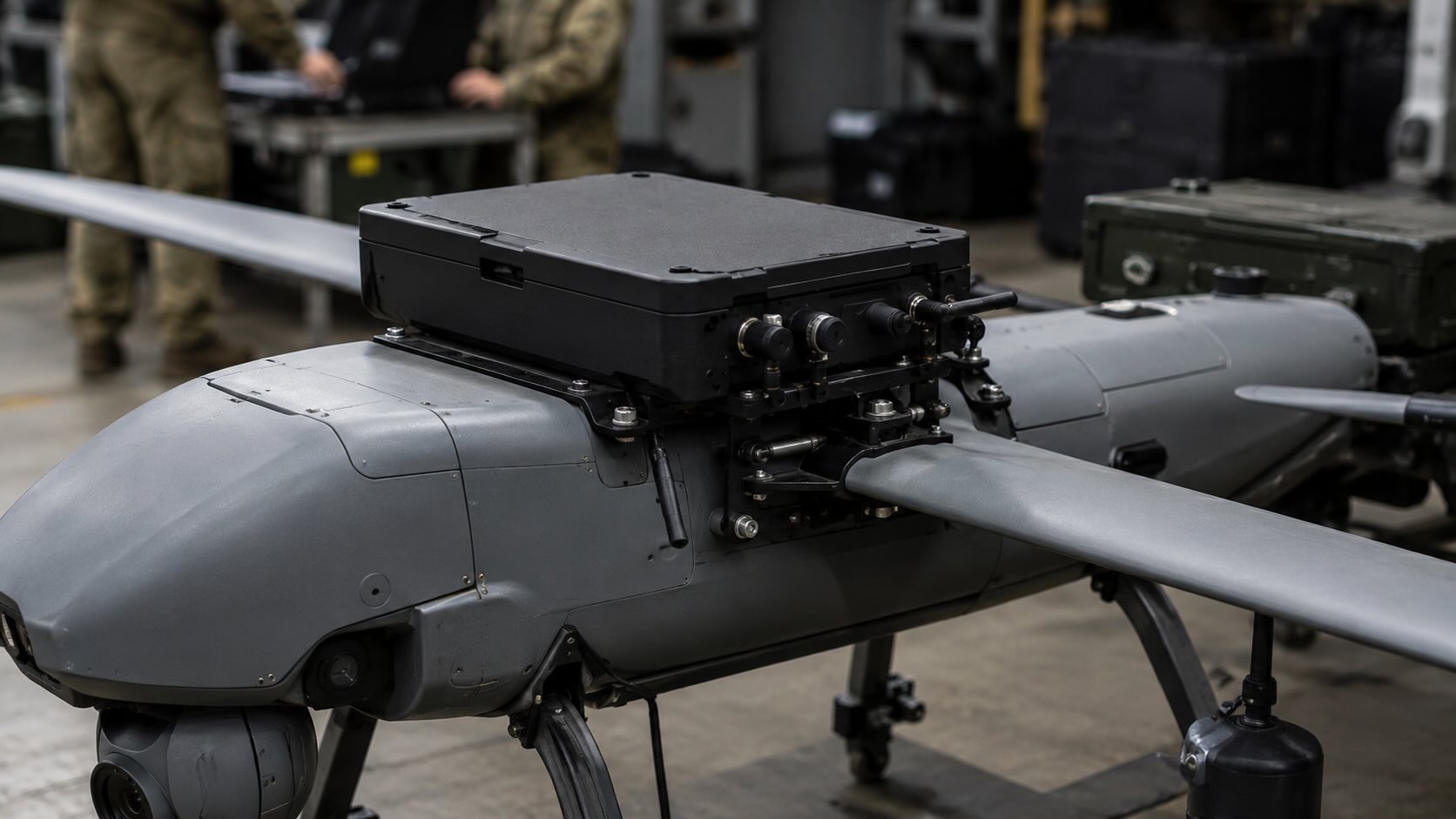
The development was announced around Prime Minister Andy Burnham’s first meeting with President Volodymyr Zelenskyy since taking office. The political choreography matters, but the industrial substance matters more. According to the initial PA report carried by ITV News, Stone Cloak is a tablet-sized system designed to make fitted drones harder for Russian forces to detect. The technology is also expected to inform Britain’s next generation of long-range weapons, including the low-cost cruise-missile effort known as Project Brakestop.
That makes the arrangement unusually reciprocal. Ukraine obtains the knowledge and authority needed to produce a battlefield-tested British capability closer to the point of use. Britain, meanwhile, is incorporating experience from the Ukrainian battlefield into its own future strike programmes.
The transfer should not be confused with another shipment of equipment. A delivery meets an immediate requirement but leaves output, repair and modification dependent on the supplier. A meaningful intellectual-property arrangement can place manufacturing data, technical documentation and production rights in the hands of the recipient. It can allow the user to build, maintain and adapt a system without waiting for each change to travel through a foreign procurement chain.
The precise Stone Cloak contract has not been made public. It is therefore too early to say whether Ukraine will acquire full ownership, an exclusive licence, source material, re-export rights or a narrower package of manufacturing permissions. “Handing over the intellectual property” is a significant political formulation, but the rights granted in the legal agreement will determine how sovereign the resulting production actually is.
Stone Cloak sits within a contest that changes too quickly for conventional upgrade cycles. Russia and Ukraine continually alter frequencies, waveforms, antenna arrangements, navigation methods and operating procedures. A protection measure that works against one detection or targeting method may lose value when the adversary identifies it and adapts.
That is why local production has an operational purpose beyond quantity. Ukrainian engineers, manufacturers and military units can shorten the loop between observing a Russian change, adjusting the system and returning an updated version to service. In a contest shaped by iteration, control over configuration and production can be as important as the performance of the first model delivered.
This does not mean a small electronic-warfare payload can make a drone invisible or invulnerable. Detection can rely on several layers, including radio-frequency emissions, radar, acoustic sensors, optical observation and the behaviour of the wider network supporting a mission. A system may reduce exposure to a particular method without defeating the entire chain. Any public description must therefore avoid turning “block detection” into a claim of universal protection.
Nor is greater production automatically equivalent to greater effect. Ukraine will need components, test equipment, quality assurance and secure facilities. Devices must remain reliable across different airframes and operating conditions. Software and manufacturing changes need configuration control, or rapid adaptation can produce incompatible versions and uncertain performance.
Those are manageable problems, but they are industrial problems rather than simply tactical ones.
The deal fits a broader change in British-Ukrainian cooperation. In a written parliamentary answer on 22 July, the Ministry of Defence said Programme LYRA had facilitated co-production arrangements, including the development of new shared intellectual property. The programme was launched in June 2025 under the two countries’ 100-Year Partnership.
Defence Matters has already examined how licensed missile production would move Western support beyond episodic aid packages. Stone Cloak provides a more concrete example of that logic. The objective is not simply to draw down a British stock and deliver it east. It is to create another production centre able to supply Ukrainian demand.
There is a resilience argument, too. Concentrating all output in Britain would leave Ukraine dependent on British factory capacity, contracting priorities and transport. Concentrating it in Ukraine creates exposure to Russian strikes. A distributed model, in which knowledge and qualified production exist in more than one country, is harder to interrupt completely.
The arrangement also reverses the familiar direction of defence-technology transfer. Ukraine has built a system for sharing its own battlefield-developed technology with partners through the Drone Deal and Build with Ukraine initiatives. Kyiv’s defence-industry portal says the framework covers joint development and localisation in drones, electronic warfare and missiles. Its streamlined transfer procedure places safeguards around end use, documentation and re-export.
Britain’s transfer of a British-developed system to Ukraine creates the mirror image: a partner entrusts sensitive knowledge to Ukrainian production. That is a stronger expression of confidence than procurement alone.
Intellectual property in a military system is not a single item. It can include design rights, software, firmware, manufacturing drawings, component specifications, test procedures, tooling knowledge and confidential know-how. Ownership of one element does not necessarily confer the right to alter or export every other element.
The UK and Ukraine will therefore need clear answers to several questions. Who approves design changes? Which party owns improvements made by Ukrainian engineers? Can Ukraine substitute components when the original part is scarce? Is production limited to Ukrainian military use? What information may be shared with subcontractors? Who bears responsibility if an unauthorised copy or cyber compromise exposes the design?
Ukraine has recognised the importance of this governance. In May, its government adopted common rules for managing intellectual property in the defence sector, presenting protection of rights as a precondition for trusted international projects and for scaling useful technology.
These controls should not be treated as bureaucracy opposed to speed. A vague agreement can delay production when engineers discover that a required modification falls outside the licence or that a component supplier cannot receive the necessary data. A well-designed agreement makes rapid production safer because authority, security and ownership are settled in advance.
There is also a British sovereign-interest question. If Stone Cloak is to feed into Project Brakestop, the UK will want the lessons generated in Ukraine without creating uncontrolled proliferation of technology intended for future British weapons. The answer is not to avoid transfer. It is to separate the rights Ukraine needs for wartime manufacture and adaptation from any restrictions legitimately required for third-country export or unrelated applications.
The immediate benchmark will be whether Ukrainian lines begin producing qualified systems in meaningful numbers. The next will be whether locally made units can be updated as Russian countermeasures evolve. Over time, the more important measure may be whether Stone Cloak creates a repeatable template for transferring other capabilities.
Ukraine’s recent agreements with Denmark, Estonia and the Netherlands show how quickly the country’s Drone Deal network has expanded. European cooperation, however, still confronts component dependencies: Defence Matters has reported that joint drone production remains exposed to Chinese motors and electronics. Stone Cloak will face the same practical test. Sovereign rights over a design are valuable, but sovereignty is incomplete if critical parts remain obtainable from only one vulnerable source.
The strategic significance of the British decision is therefore conditional but real. It recognises that the most durable form of support is not permanent Ukrainian dependence on deliveries. It is the capacity to manufacture, repair and improve equipment inside an allied industrial network.
Thousands of finished devices can affect today’s operations. The transfer of the knowledge behind them can affect the next production cycle, the next Russian adaptation and the design of future British weapons. Stone Cloak is thus less a story about a tablet-sized jammer than about who controls the ability to keep a military technology useful after the first shipment has been consumed, damaged or overtaken by the battlefield.


Why Slotless Motor Technology Could Transform the Next Generation of UAVs