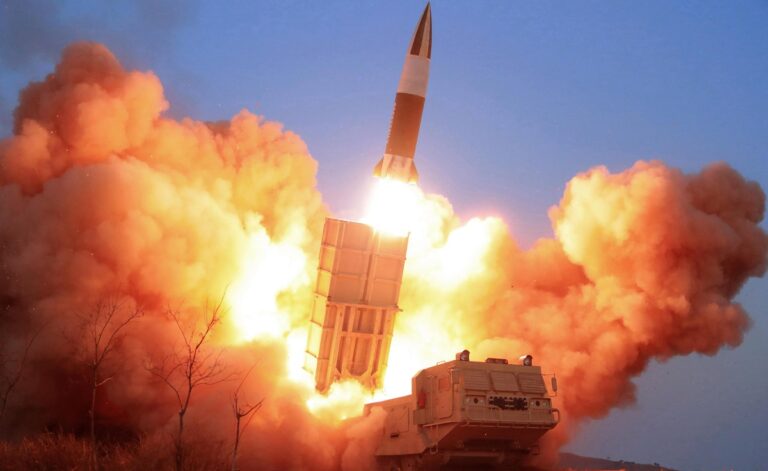
The United States’ reported use of nearly all available long-range battlefield missiles during the Iran war has exposed a familiar problem in modern warfare: precision weapons can be decisive, but they can also be consumed faster than industry can replace them.
Reuters reported that US forces used virtually all of their available stocks of Army Tactical Missile Systems and Precision Strike Missiles during the campaign, while also expending a substantial number of Tomahawk cruise missiles. The report was based on three sources and has not been independently verified. The White House and Pentagon have disputed any suggestion that US readiness was compromised.
Those caveats matter. Stockpile figures are among the most sensitive parts of defence reporting, and anonymous-source assessments can be incomplete or politically contested. But even if the precise numbers remain disputed, the issue raised by the report is real: the United States and its allies are entering an era in which long-range fires are both more central to military planning and more vulnerable to rapid depletion.
The Iran war was a reminder that modern strike campaigns are not only measured by the targets hit. They are also measured by the inventories used to hit them.
ATACMS, PrSM and Tomahawk serve different operational roles, but they belong to the same family of scarce, high-value effects. They allow commanders to strike command nodes, air-defence sites, missile launchers, logistics hubs and hardened infrastructure at distances that reduce risk to aircraft and personnel. That makes them attractive in the opening phase of a conflict, especially against a state with air defences, ballistic missiles and dispersed military infrastructure.
The problem is that such weapons are not artillery shells. They are expensive, complex and produced through supply chains that cannot be expanded overnight. If a short, intense campaign consumes large parts of available stockpiles, planners must ask how much capacity remains for deterrence elsewhere, including the Indo-Pacific, Europe and continuing support to Ukraine.
Defence Matters has previously examined how the Iran war created pressure on US missile inventories in its report on years of key missile stocks being burned through in the campaign. The new reporting sharpens that question by focusing specifically on battlefield long-range missiles and the gap between operational demand and replenishment.
Ukraine has already shown why long-range fires matter. Kyiv has used Western-supplied precision weapons and domestically produced drones to strike airfields, logistics centres, fuel infrastructure and military-industrial sites far beyond the front line. Russia has used ballistic and cruise missiles, drones and glide bombs to impose a continuous defensive burden on Ukrainian cities and air defences.
The lesson for NATO is not that every war will look like Ukraine. It is that states now plan for deep fires as a normal feature of conflict, not an exceptional capability held in reserve for rare targets.
That has consequences for procurement. If the United States consumes a large share of key munitions in one regional war, European allies cannot assume that American inventories will always be available to cover simultaneous contingencies. The same pressure applies to air-defence interceptors, counter-drone systems and maritime strike weapons.
For Europe, this is not only an American problem. Many European armies have smaller stocks, slower production cycles and more fragmented procurement systems. They are increasing defence budgets, but industrial output remains uneven. The danger is that governments buy exquisite platforms while underinvesting in the missiles, spares and munitions that make those platforms militarily useful.
The central readiness question is endurance. A military can look formidable if it can deliver a powerful first salvo. It is less credible if it cannot repeat the effect, replace losses or sustain pressure beyond the opening phase.
Long-range missiles are especially important because they allow armed forces to shape the battlefield before ground or air forces move. If stocks are thin, commanders face harder choices: whether to reserve weapons for deterrence, spend them early to suppress enemy systems, or limit operations to preserve inventories for a wider escalation.
The reported US use in Iran also has political consequences. Congress will face pressure to fund replenishment. Contractors will seek longer production commitments. Allies may be encouraged to buy more US systems, but they may also question whether dependence on US inventories exposes them to American operational priorities.
The Pentagon can credibly argue that classified readiness assessments should not be reduced to a single inventory figure. It can also argue that the purpose of stockpiles is to be used in war. Both points are true. But the strategic question remains: how quickly can used stockpiles be rebuilt, and at what cost to other theatres?
The Iran campaign may have demonstrated US reach. It also appears to have demonstrated the price of relying on scarce precision munitions in a world where more than one crisis can demand them at once.