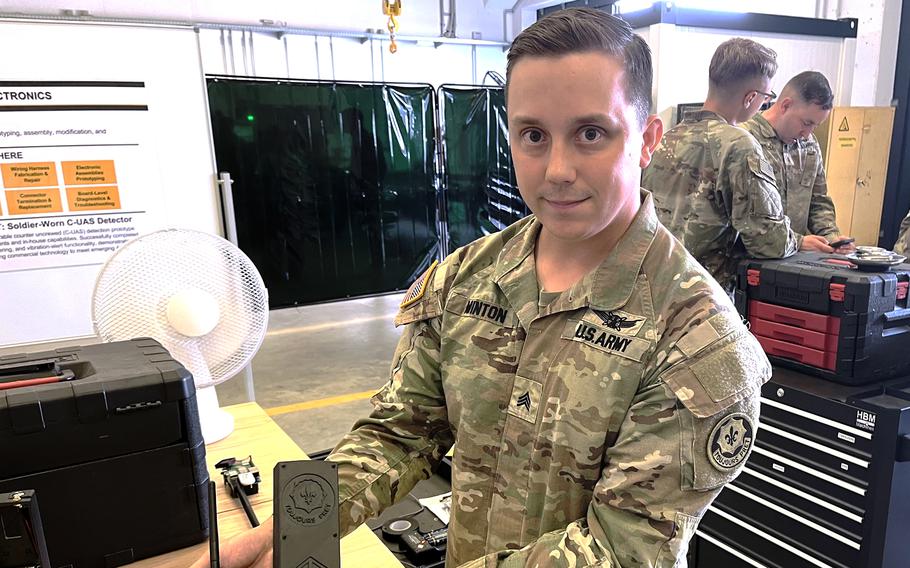
Against this backdrop, one of the most encouraging developments has emerged not from a major defence contractor, but from a US Army sergeant working in Bavaria.
The prototype wearable drone detector developed by Sgt. Ryan Minton illustrates an increasingly important shift in military innovation: empowering those closest to operational challenges to develop practical solutions quickly, affordably and at scale.
The concept itself is elegantly simple. The compact device continuously scans for radio-frequency signals associated with nearby drones and alerts the wearer through either an audible alarm or vibration. Rather than relying on expensive, vehicle-mounted detection systems, Minton’s invention can be carried by individual soldiers much like standard protective equipment.
Its greatest strength may lie in its affordability. Constructed from commercially available electronic components costing less than $120, each detector can be assembled in under an hour. At a time when many defence programmes require years of development and billions of dollars in investment, such economics are striking.
The timing could hardly be more appropriate.
The conflict in Ukraine has demonstrated with brutal clarity that inexpensive drones have transformed modern combat. Commercial quadcopters adapted for military use now conduct reconnaissance, direct artillery, attack vehicles and threaten infantry on an almost continuous basis. The battlefield has become three-dimensional, forcing soldiers to monitor threats not only across the terrain but above their heads.
This evolution has challenged military planners throughout NATO. Traditional air-defence systems were never designed to counter thousands of low-cost drones operating simultaneously. Instead, armies increasingly require layered solutions that combine sophisticated strategic systems with inexpensive tactical equipment deployed directly to frontline troops.
Minton’s detector fits precisely into this emerging doctrine.
Equally significant is where the project has matured. Rather than remaining an isolated personal experiment, the invention has been incorporated into the US Army’s newly established Design Innovation Research and Testing (DIRT) Lab in Bavaria. The facility represents a broader institutional recognition that military innovation should not be confined to traditional procurement channels.
Instead, engineers, soldiers and researchers collaborate under one roof using additive manufacturing, rapid prototyping, electronics development and textile fabrication to produce practical battlefield solutions within remarkably short timescales.
This model mirrors developments increasingly visible across NATO.
Rapid innovation hubs, defence accelerators and partnerships between military organisations, universities and private industry are becoming essential features of Western defence planning. The objective is no longer simply technological superiority but technological agility.
Europe, in particular, has recognised that drone technology will remain central to future defence capabilities. Investment across the continent has accelerated dramatically as governments seek both greater strategic autonomy and stronger industrial resilience in emerging technologies.
What makes projects such as Minton’s especially valuable is that they demonstrate innovation does not always require revolutionary scientific breakthroughs.
Affordable sensors, open-source electronics, 3D printing and commercial manufacturing techniques now allow small teams to solve highly specialised operational problems at remarkable speed. The result is an innovation cycle measured in weeks rather than years.
This democratisation of defence technology could become one of NATO’s greatest competitive advantages.
Authoritarian states often excel at centralised production, but decentralised innovation remains considerably harder to replicate. Allowing soldiers themselves to identify operational gaps and rapidly prototype solutions creates a continuous stream of incremental improvements that collectively enhance battlefield effectiveness.
The wearable detector also offers considerable export potential within the Alliance.
Should ongoing testing at Germany’s Grafenwoehr Training Area prove successful, similar systems could be adopted across NATO forces, providing affordable protection not only for combat troops but also logistics units, engineers and humanitarian personnel operating in contested environments.
Perhaps most importantly, the project reflects a welcome cultural shift within military organisations.
For decades, valuable ideas generated at unit level often struggled to navigate complex procurement systems. Innovation laboratories such as Bavaria’s DIRT facility recognise that operational expertise frequently resides with the soldiers confronting evolving threats every day.
By giving those personnel access to modern manufacturing tools, engineering expertise and institutional support, militaries can significantly accelerate capability development while reducing costs.
The future battlefield will undoubtedly become even more technologically complex. Artificial intelligence, autonomous systems, electronic warfare and increasingly sophisticated drones will continue to reshape military operations.
Meeting those challenges will require not only larger defence budgets but also faster learning, greater flexibility and a willingness to embrace practical ideas wherever they emerge.
In that respect, a wearable drone detector assembled from inexpensive components in a Bavarian innovation laboratory represents something larger than a single invention. It is evidence that modern defence is becoming more adaptive, more collaborative and ultimately more resilient.
Sometimes the most significant advances do not begin in corporate boardrooms or government ministries. They begin with one soldier identifying a problem, building a solution and being given the opportunity to turn ingenuity into capability. That may prove one of the most valuable strategic assets Western defence possesses.