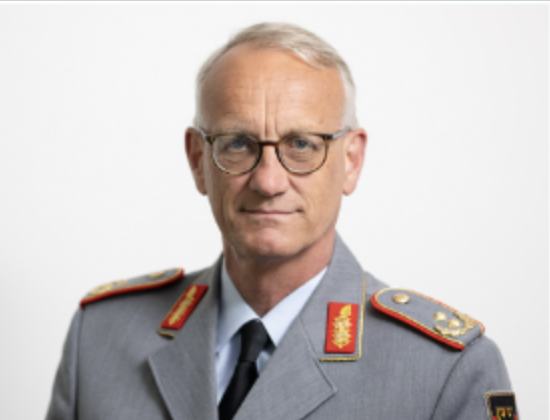
His description of Donald Trump as an “egomaniac, narcissistic, erratic dealmaker with authoritarian leanings” will reverberate far beyond the lecture hall of the German-British Society where it was uttered. The words matter not merely because of their bluntness, but because they reveal an anxiety now embedded deep in Europe’s strategic thinking: the guarantor of its security has become unpredictable.
Stahl’s broader warning was darker still. Germany, he argued, is already under continual assault from Russia through non-military means. Hybrid warfare, cyber interference, economic pressure and disinformation campaigns are no longer theoretical concepts but routine features of the political landscape. And in his assessment Vladimir Putin is on a “mission against the West”, one that may culminate in open aggression against Nato if opportunity presents itself.
“When I see how Putin has acted up to now,” he said, “there is no question of whether he will use military means. If he gets the opportunity, he will use them.” It is a strikingly stark judgement from a senior officer in Europe’s largest economy.
Germany is currently hosting Nato’s Steadfast Dart exercise, moving some 7,300 troops across central and southern Europe to test whether reinforcements could be rushed eastward at speed. Yet the manoeuvres take place against a backdrop of unease. A much-discussed German war game – broadcast by Die Welt as the “Ernstfall” podcast – imagined Russia seizing the Suwalki Gap, the narrow corridor linking Poland to Lithuania and thus the Baltic states to the rest of Nato. In the scenario Lithuania invoked Article 5. The United States hesitated. The alliance froze.
Such exercises are not predictions but stress tests. Nevertheless they reveal the fragility of assumptions that have underpinned European security for three decades. Nato’s strength lies not only in its military assets but in the credibility of American commitment. If that credibility wavers, deterrence itself begins to erode.
Stahl insists American officials continue to assure him that Washington remains fully committed, particularly regarding the nuclear umbrella. Yet these assurances sit uneasily alongside the rhetoric and negotiating style of a president who frequently treats alliances as transactions. The general’s “biggest intellectual challenge”, as he put it, is reconciling the steadiness of US institutions with the volatility of US leadership.
Europe’s difficulty, however, is not solely transatlantic. It is also institutional. The continent has spent years constructing a political architecture designed for consensus, deliberation and regulatory precision — admirable qualities in peacetime, less useful in crisis.
At European Union level the executive authority lies with the European Commission. In theory it provides coherence; in practice it often provides only process. The Commission must balance 27 national interests, legal competencies and parliamentary scrutiny before acting. That structure works tolerably well for agricultural standards or digital regulation. It is far less suited to sudden geopolitical shocks.
Security crises demand speed. Yet Brussels’ machinery is famously methodical. Sanctions packages take negotiation, defence initiatives require coordination, and emergency responses frequently depend upon unanimous consent among governments with divergent threat perceptions. Critics increasingly argue that the EU’s executive centre struggles to take decisive action at the pace modern crises require.
This matters because Russia’s strategy exploits precisely such hesitation. Hybrid warfare thrives in the grey zone between peace and war — the space where legal definitions, bureaucratic competence and political caution overlap. A cyberattack on infrastructure, migrant pressure on borders, energy supply manipulation: each can fall below the threshold that triggers immediate collective action.
Nato, by contrast, is built for rapid military response but depends on political clarity. The EU possesses economic weight but institutional complexity. Europe therefore risks being caught between two systems: one powerful but politically uncertain, the other politically structured but operationally slow.
Stahl worries Germany itself may hesitate at the decisive moment. If Russian troops were to occupy a sliver of Nato territory — the Estonian city of Narva often serves as the hypothetical example — he fears calls for negotiation would quickly overwhelm calls for action. The instinct for diplomacy is understandable in a nation shaped by the trauma of its 20th-century history. Yet deterrence depends upon certainty. Occupied territory must be restored, not merely protested.
Chancellor Friedrich Merz has ruled out a German nuclear arsenal but suggested German aircraft could theoretically carry British or French warheads. The technicalities remain unclear — Britain’s deterrent is submarine-based and France’s fiercely independent — yet the symbolism is unmistakable. Europe is beginning, cautiously and awkwardly, to contemplate security arrangements once considered unnecessary.
Stahl rejects talk of proliferation, noting that US nuclear guarantees remain intact. But the fact that Poland debates its own deterrent and Germany discusses nuclear sharing beyond America indicates how profoundly strategic confidence has shifted.
There is also the domestic dimension. Stahl warns that Germany’s internal resilience is under strain. The four pillars of its security — the EU, Nato, economic strength and social cohesion — are all under pressure. He suggests civil defence preparedness has been neglected and that Germany’s complex federal system could struggle in a fast-moving emergency.
He also points to the rise of the Alternative for Germany as an anti-democratic force capable of unsettling political stability. His remark that voters must “vote the right way” to protect liberal democracy edges into political territory traditionally avoided by serving officers, yet it reflects a broader concern: external threats now intertwine with internal division.
“The world is coming apart at the seams,” he said. “It’s turbulent. It’s rough. It’s lawless.”
Hyperbole perhaps, but Europe’s post-Cold War assumptions have undeniably collapsed. Economic integration did not end geopolitical rivalry. Strategic dependence did not eliminate strategic risk. And institutional complexity has not produced strategic agility.
The uncomfortable truth underlying Stahl’s warning is this: Europe faces a test not only of military preparedness but of political decisiveness. Nato requires resolve. The EU requires speed. Both require public confidence.
If Washington’s reliability is questioned and Brussels’ responsiveness doubted, the Kremlin’s calculus changes. Deterrence is psychological before it is military. Hesitation — whether in Berlin, Brussels or Washington — is itself a strategic vulnerability.
Stahl’s remarks may be diplomatically awkward. Yet they articulate a growing European fear: that in a harsher world, the continent’s greatest weakness may not be insufficient weapons, but insufficient decisiveness.