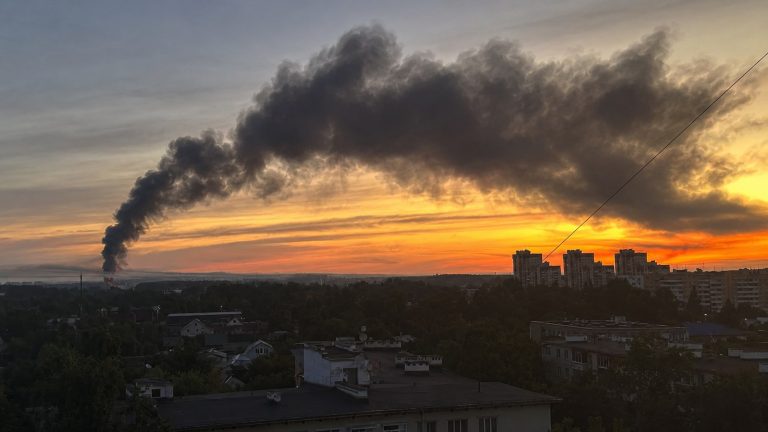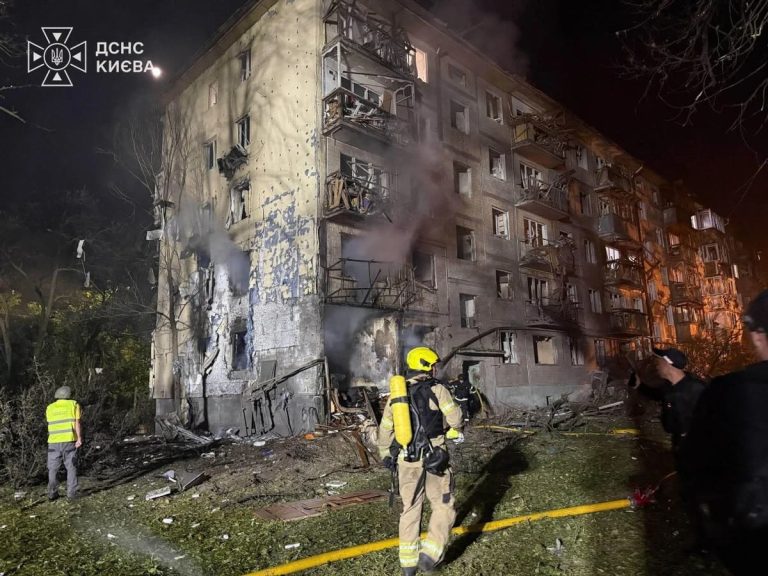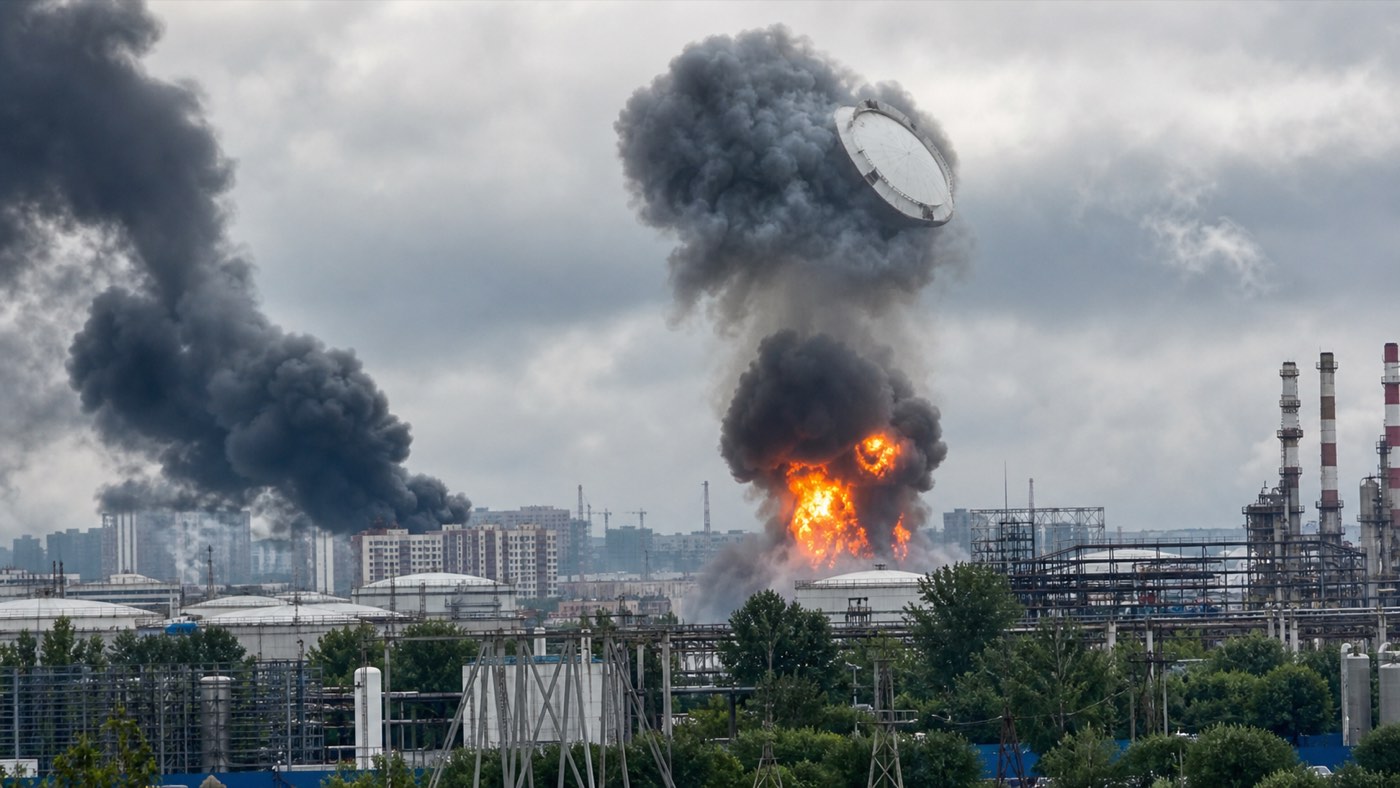
Ukraine’s drone strike on a Moscow oil refinery on 18 June has exposed a new vulnerability in Russia’s home-front defence: the fuel system serving its own capital.
Ukraine’s major drone attack on Moscow caused disruption to refinery operations, flights and Russian air-defence activity. The strike hit the Kapotnya oil refinery, one of the capital’s key energy facilities, while air traffic was disrupted at several Moscow airports. Russian authorities claimed to have intercepted large numbers of drones, but the fact that several reached infrastructure inside the capital raises a more important operational question.
Ukraine’s long-range drone campaign is no longer only about demonstrating reach. It is increasingly aimed at stressing Russia’s fuel supply, forcing air-defence reallocations and making the war visible inside Russia’s most politically protected urban space.
Early Ukrainian drone attacks deep inside Russia often carried symbolic value. They showed that Moscow, airbases and military-industrial sites were not beyond reach. The 18 June strike belongs to a different category.
A refinery is not only an industrial target. It is part of the economic system that keeps transport, military logistics, emergency services and civilian mobility functioning. The Kapotnya refinery has been described in reporting as a major supplier of petrol and diesel for Moscow. Any disruption therefore has significance beyond the immediate fire or damage assessment.
Ukraine has spent months increasing attacks on Russian refineries, ports, depots and logistics nodes. The purpose is not simply retaliation. It is to reduce Russia’s ability to convert energy infrastructure into military endurance and state revenue. Fuel is a battlefield input even when it is produced far from the front.
The Moscow strike brings that logic closer to the political centre of Russia. Hitting oil infrastructure in remote regions imposes economic and logistical costs. Hitting fuel infrastructure around Moscow also tests the perception that the capital is shielded from the war Russia has brought to Ukraine.
The second issue is air defence. Moscow is one of the most heavily defended cities in Russia. If Ukrainian drones can penetrate multiple layers of protection and reach refinery infrastructure, even in limited numbers, Russia faces a serious allocation problem.
Air defence is finite. Systems protecting Moscow cannot simultaneously protect refineries in the Volga region, oil export terminals, ammunition depots, airbases, command sites and occupied Crimea. Every Ukrainian long-range strike forces Russia to decide what matters most.
That is the strategic value of repeated drone attacks. Even when most drones are intercepted, the defender must keep radars active, crews alert, missiles stocked and airspace controls ready. If drones reach their targets anyway, the political cost rises. If Russia shifts more air defence to Moscow, other military and industrial sites may become more exposed.
The disruption to commercial flights also matters. Airport closures and delays are not battlefield effects in the narrow sense, but they are signs that Ukraine’s drone campaign can interfere with normal life and economic activity inside Russia. That is precisely the kind of pressure Moscow has tried to impose on Ukrainian cities through missile and drone attacks.
The refinery strike should be seen alongside Ukraine’s broader campaign against Russian energy infrastructure. Refineries are attractive targets because they sit between raw oil production and usable military or civilian fuel. Damaging processing units can create bottlenecks even when crude oil production continues.
Russia is a major oil producer, but refined products are a different problem. If refineries are damaged, fuel has to be rerouted, imported, stockpiled or rationed. That can create local shortages, increase costs and complicate logistics.
The direct military effect of one strike may be limited. Russia has redundancy and repair capacity. But the cumulative effect of repeated attacks is different. Repair crews, spare parts, insurance, transport networks, fuel allocation and air-defence coverage all come under pressure at the same time.
For Ukraine, drones offer a way to impose those costs without matching Russia missile for missile. Long-range unmanned systems are cheaper than ballistic or cruise missiles and can be produced in larger numbers. They also allow Kyiv to attack economic nodes that support Russia’s war effort while avoiding direct dependence on scarce Western long-range missiles.
The Moscow strike also carries escalation risk. Russian officials and hardliners have used previous attacks inside Russia to call for harsher retaliation against Ukraine. Moscow’s foreign ministry signalled that Russia would respond with large-scale strikes, while Russian forces continued their own missile and drone attacks on Ukrainian cities.
That does not make Ukraine’s campaign irrational. Ukraine is responding to a war in which Russia has repeatedly targeted energy infrastructure, cities, ports and cultural sites. But the closer Ukrainian drones come to Moscow’s core infrastructure, the more Russia may seek to frame the attacks as justification for expanded retaliation.
The operational balance is therefore delicate. Kyiv wants to raise the cost of Russia’s war, disrupt fuel and logistics, and challenge the Kremlin’s claim that the conflict can be contained away from Russian society. At the same time, Ukraine must calculate how strikes inside Russia affect allied perceptions, escalation management and future support.
The 18 June attack is important because it brings several trends together: Ukraine’s growing long-range drone capacity, Russia’s dependence on vulnerable fuel infrastructure, and the limits of defending a vast country against persistent low-cost aerial attacks.
The attack does not mean Ukraine can shut down Russia’s fuel system at will. But it shows that Moscow’s home front is no longer insulated from the industrial logic of the war. Refineries, airports and air-defence networks are now part of the same contest.
Ukraine’s drone war has reached Russia’s fuel system. The question is whether Moscow can defend that system without weakening protection elsewhere.