

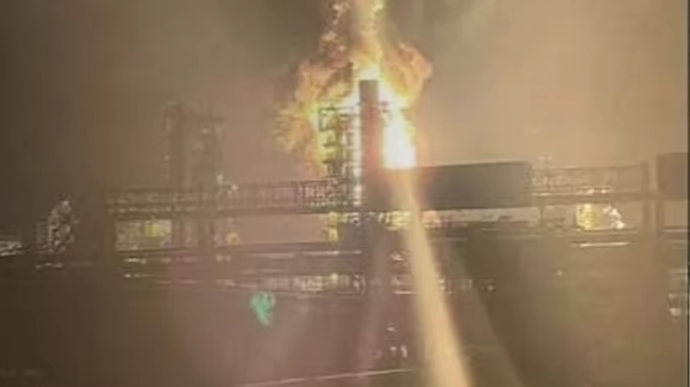
Ukraine’s General Staff said explosions and a fire were recorded at the plant and that the results of the strike were being assessed.
Russian officials reported a fire at the refinery following the attack. Alexander Drozdenko, governor of Leningrad Oblast, said three drones were downed in the Kirishi area and that falling debris sparked a blaze on the facility’s premises. He claimed the fire was extinguished and reported no casualties.
The refinery, operated by Surgutneftegaz’s Kirishinefteorgsintez, processes about 17.7 million tonnes of crude a year—roughly 355,000 barrels per day—which amounts to around 6.4% of Russia’s total refining capacity, according to industry figures cited by Russian and international media. It is routinely listed among the country’s largest refining complexes.
Kirishi lies to the south-east of St Petersburg; open sources place the town at roughly 110–115km from the city. The plant is a key supplier in north-west Russia and is sometimes referred to by its acronym, KINEF.
Ukraine framed the operation as a joint action by Special Operations Forces and the Unmanned Systems command. The announcement referenced the involvement of Robert ‘Madyar’ Brovdi, the Unmanned Systems Forces commander, and said the refinery is among Russia’s leaders by annual throughput. The General Staff added that visual evidence of explosions and a subsequent fire was recorded at the site.
Drozdenko’s remarks emphasised air defences had intercepted the incoming drones before debris caused the blaze. Subsequent statements from regional officials and emergency services said the fire had been contained without injuries. International agencies reporting from the governor’s Telegram channel echoed those details, while noting there was no immediate independent assessment of structural damage at the plant.
Reuters reported that Ukraine’s drone command said it had carried out a “successful strike”. At the time of publication, the extent of damage—if any—could not be independently verified. Both sides’ claims are being cross-checked by outlets monitoring satellite heat signatures and open-source imagery.
The Kirishi attack follows earlier incidents targeting Russian energy infrastructure. In March this year, Russian authorities said debris from intercepted drones damaged a tank at the same refinery. Ukraine has repeatedly targeted refineries and related facilities across multiple regions since 2024, arguing such sites support Russia’s war effort. Reuters+1
There have also been recent strikes in the wider area. On 12 September, Ukrainian security service drones were reported to have attacked Primorsk, Russia’s largest Baltic oil-loading port. Local and national Russian channels have regularly reported short-lived fires or shutdowns after drone activity, while Moscow has typically stated that production continues or resumes swiftly.
KINEF’s scale means any sustained disruption would be closely watched by commodity markets, but Russian officials have not indicated a halt in operations after the latest incident. Previous refinery attacks inside Russia have produced varied operational outcomes, from brief pauses to partial unit outages; in many cases authorities claimed output was unaffected.
As of Sunday morning, Kyiv had not released details of the munitions used, range flown, or assessed damage to specific process units. Unofficial Russian and Ukrainian channels circulated claims about impacts on primary crude distillation equipment, but these could not be verified at source. Ukraine’s General Staff said it would provide further information once battle damage assessment was complete.
The Kirishi strike forms part of a wider pattern of longer-range Ukrainian drone operations beyond the front line. Such actions have targeted refineries, fuel depots and logistics nodes across Russia in recent months, alongside continued Russian strikes on Ukrainian energy assets. The tempo and reach of these attacks have increased during 2025.
Drone Strike Forces Suspension at Russia’s Primorsk Oil Terminal



