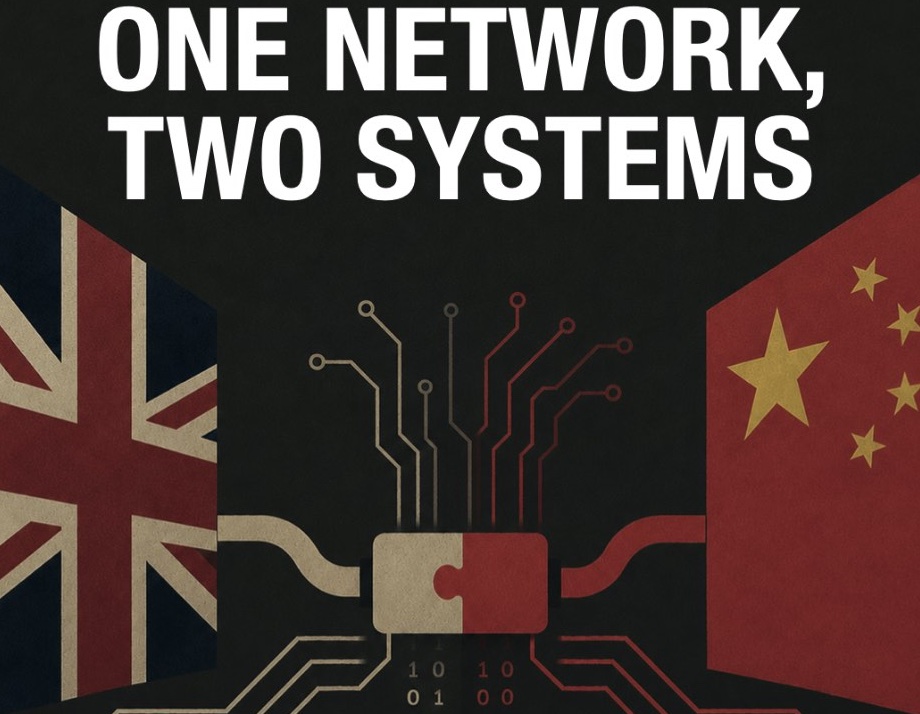
Produced by UK-China Transparency and authored by Eugenio Benincasa, the paper is notable not for rhetorical flourish but for the painstaking accumulation of evidence.
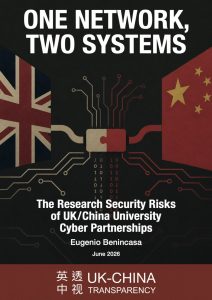
It presents an uncomfortable proposition: that Britain has become Europe’s most deeply embedded partner in China’s university cyber ecosystem at precisely the moment when Beijing has made little secret of integrating civilian research with national strategic objectives.
The report does not argue that academic collaboration with China should cease. On the contrary, it explicitly acknowledges the scientific and economic benefits generated by decades of cooperation. Instead, it contends that Britain has failed to distinguish sufficiently between legitimate academic exchange and partnerships involving institutions structurally integrated into China’s defence and security apparatus.
That distinction matters.
Benincasa’s central argument rests upon what he describes as an asymmetry between two research systems. British universities may collaborate with defence agencies, but such relationships remain project-specific, voluntary and institutionally separate from civilian research. China’s Military-Civil Fusion strategy operates on a different principle altogether. Under that model, civilian institutions are expected to contribute directly to national security objectives, blurring the traditional boundaries separating commercial, academic and military research.
Whether one accepts every implication of this analysis is almost beside the point. The report demonstrates that these structural differences cannot simply be wished away through assumptions of academic reciprocity.
Perhaps the report’s greatest strength lies in its empirical approach. Rather than relying upon broad geopolitical observations, it maps 34 cyber-related partnerships between British and Chinese universities and identifies thirteen involving institutions closely linked to China’s defence establishment, including universities authorised to conduct classified military research. It argues that Britain now maintains more such relationships than any European country and, in some respects, more than almost any country outside China itself.
The detailed case studies reinforce the argument. The examination of the long-standing relationship between Queen Mary University of London and Beijing University of Posts and Telecommunications illustrates how deeply institutionalised such cooperation has become through joint degrees, shared laboratories, doctoral supervision and extensive co-authored research. The discussion of Beihang University similarly demonstrates that collaboration extends beyond formal agreements into researcher-level networks that may be less visible but are potentially no less significant.
Importantly, the report avoids caricature. It repeatedly emphasises that research security should not become a pretext for indiscriminate disengagement from China. Its recommendations advocate targeted risk management rather than wholesale academic decoupling, including the creation of a UK list of high-risk research organisations, dedicated university research security officers, financial support to reduce dependence on high-risk partnerships, and improved security briefings for academics travelling to China.
These recommendations appear measured rather than ideological.
What is more striking is the comparison with Britain’s allies. According to the report, the United States, Canada, Taiwan, Belgium, Switzerland, Japan and several leading universities have already introduced substantially stronger safeguards governing cooperation with Chinese defence-linked institutions. Britain, by contrast, continues largely to rely upon advisory guidance and institutional discretion rather than explicit restrictions.
That observation inevitably raises broader questions for British policymakers.
For much of the past decade successive governments have recognised China as presenting an increasingly complex strategic challenge. Intelligence agencies have issued repeated warnings regarding cyber operations, technology acquisition and foreign interference. Yet higher education policy often appears to have evolved more slowly than the threat environment itself.
Whether this reflects political caution, competing economic priorities or institutional inertia is open to debate. Universities have become financially dependent upon international partnerships and overseas students, while Whitehall departments frequently balance commercial, diplomatic and security considerations simultaneously. The result can be a policy framework that appears reactive rather than strategic.
The report invites an even more uncomfortable question: does the present British state fully appreciate how profoundly the Chinese Communist Party integrates scientific advancement into long-term national strategy?
That question extends beyond ministers. Britain’s Civil Service has traditionally excelled at managing departmental responsibilities within clearly defined policy boundaries. China’s statecraft, however, often disregards those distinctions, treating technology, education, industrial policy, intelligence and military modernisation as components of a single strategic system. If democratic governments continue approaching these domains in isolation while Beijing approaches them as one integrated enterprise, there is a genuine risk of strategic asymmetry.
This does not imply that Britain should abandon openness, nor should Chinese students or researchers become objects of unwarranted suspicion. The overwhelming majority pursue entirely legitimate academic work. Indeed, the report itself explicitly argues against blanket restrictions and stresses proportionate, evidence-based responses.
Nevertheless, openness cannot mean strategic naivety.
Britain’s universities remain among its greatest national assets, driving innovation, attracting global talent and strengthening economic competitiveness. Protecting those strengths requires recognising that research security has become inseparable from national security.
One Network, Two Systems succeeds because it reframes the debate. Rather than asking whether Britain should collaborate with China, it asks a more sophisticated question: under what conditions, with which institutions, and under what safeguards should collaboration continue?
Those are questions that deserve urgent answers—not only from vice-chancellors but from Whitehall, Parliament and the National Security Council. If the report is even broadly correct in its diagnosis, Britain has already entered a strategic competition in which academic partnerships are no longer peripheral. They have become part of the national security landscape itself.