NATO’s decision to modernise its nuclear capabilities and strengthen nuclear-planning capacity marks a significant shift in alliance deterrence policy ahead of the Ankara summit.
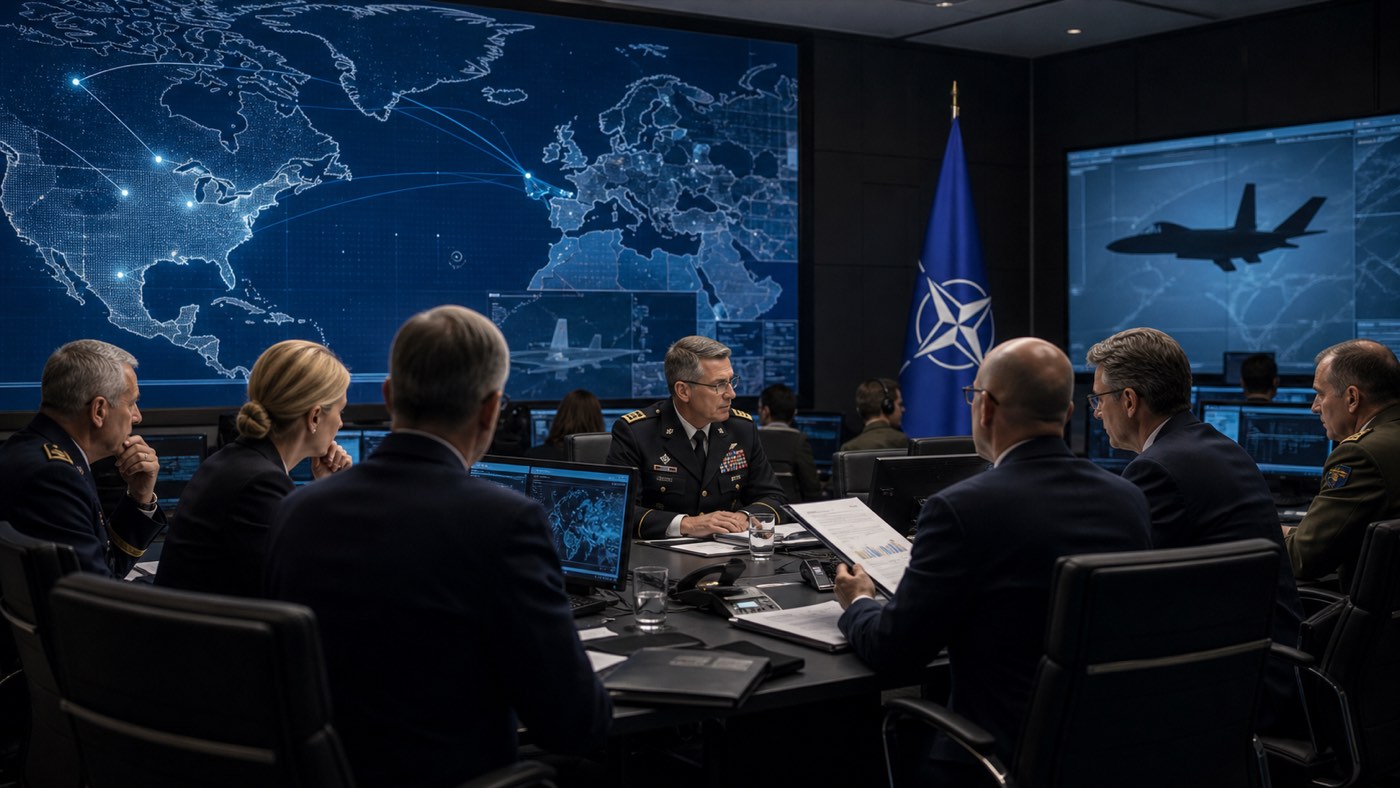
The alliance’s Nuclear Planning Group, NATO’s senior body for nuclear deterrence consultation and decision-making, said on 18 June that allies had agreed to modernise nuclear capabilities and reinforce planning capacity. All NATO allies except France participate in the group, which is the forum through which the alliance consults on nuclear policy and posture.
The statement is formal and carefully worded. Its significance lies in the context around it. NATO is moving from broad reassurance language into more practical nuclear-planning adaptation at the same time as Russia continues to use nuclear signalling, the United States is reviewing parts of its European force posture, and European allies are being pushed to carry more of the conventional defence burden.
For much of the post-Cold War period, NATO nuclear policy sat in the background of alliance politics. It remained central to deterrence doctrine, but it was rarely the most visible part of summit diplomacy. Russia’s full-scale war against Ukraine changed that.
Moscow has repeatedly used nuclear rhetoric to shape Western decision-making, intimidate European publics and discourage deeper support for Kyiv. At the same time, Russia has invested in dual-capable systems, long-range strike assets and strategic forces that complicate NATO planning across the European theatre.
Against that backdrop, modernisation is not only a technical question. It is a political signal that NATO does not intend to allow its nuclear posture to become outdated while Russia combines conventional war, missile pressure and nuclear messaging.
The key issue is not whether NATO is announcing a new nuclear doctrine. It is whether the alliance is adapting the planning machinery behind deterrence: consultation, readiness, command arrangements, exercises, safety, survivability and the integration of nuclear policy with wider defence planning.
The Nuclear Planning Group statement lands at a moment when Europe’s role inside NATO is already being redefined.
At the same Brussels ministerial cycle, US Defence Secretary Pete Hegseth pressed European allies to take greater responsibility for their own defence, warning that the era of “free-riding” was over. Current reporting also points to a US review of the benefits and costs of keeping forces in Europe. Even if Washington remains committed to NATO, the message is clear: European governments are expected to do more.
That pressure is usually discussed in conventional terms: tanks, air defence, ammunition, drones, logistics and industrial output. But nuclear deterrence cannot be separated from that debate. NATO’s nuclear posture is ultimately tied to the credibility of the whole alliance. If conventional readiness weakens, nuclear signalling becomes more important but also more dangerous. If conventional deterrence strengthens, nuclear deterrence sits within a more stable overall posture.
For European allies, the question is therefore uncomfortable. They do not control the US nuclear arsenal. France maintains an independent nuclear deterrent outside NATO’s Nuclear Planning Group. The United Kingdom is both a NATO nuclear power and a European ally under pressure to increase defence spending. Non-nuclear allies participate in planning and hosting arrangements, but they also face domestic political sensitivities over nuclear policy.
Modernising nuclear planning means navigating all of those realities while keeping alliance cohesion intact.
The phrase “strengthen nuclear planning capacity” deserves attention because it points to the less visible work that makes deterrence credible.
Deterrence does not depend only on the existence of nuclear weapons. It depends on decision-making structures, political consultation, secure communications, command resilience, trained personnel, credible exercises and the ability to signal resolve without losing escalation control.
That is why nuclear planning is different from nuclear rhetoric. Public statements can reassure allies or warn adversaries. Planning determines whether the alliance can act coherently under pressure.
Russia’s war has shown how quickly conventional, cyber, missile and nuclear dimensions can interact. A crisis in the Baltic region, the Black Sea or the High North would not unfold neatly in separate categories. NATO planners must assume that Russia could combine conventional mobilisation, hybrid attacks, long-range strikes, cyber disruption and nuclear threats in the same crisis.
Strengthening nuclear-planning capacity is therefore part of a broader resilience problem. It asks whether NATO can consult, decide and communicate under stress, especially if its command networks, political capitals or critical infrastructure are targeted.
The Ankara summit is likely to focus heavily on defence spending, European burden-sharing and the alliance’s eastern flank. Nuclear modernisation will sit behind those debates, but it may prove just as consequential.
The challenge for NATO leaders is to avoid two opposite mistakes. One would be to treat nuclear modernisation as a symbolic statement that does little to improve real planning. The other would be to allow nuclear adaptation to substitute for conventional investment.
NATO needs both. Nuclear deterrence remains the ultimate guarantee of alliance security, but it cannot compensate for thin air defence, weak logistics, inadequate ammunition stocks or fragmented European procurement. A credible nuclear posture is strongest when backed by conventional forces capable of deterring aggression below the nuclear threshold.
Defence Matters has recently examined how NATO’s rear areas can no longer be treated as safe assumptions. The same logic applies to nuclear planning. Deterrence depends not only on weapons, but on the protected systems, bases, communications and political procedures that allow the alliance to manage escalation.
NATO’s latest nuclear move should not be read as a sudden break with existing policy. The alliance has long described nuclear deterrence as a core element of its security. What has changed is the pressure around that policy.
Russia is more openly coercive. The United States is demanding more from Europe. European conventional readiness remains uneven. The defence-industrial base is still struggling to match the scale of demand created by the war in Ukraine. Under those conditions, nuclear planning cannot remain a background file.
The Nuclear Planning Group’s statement is therefore best understood as a recalibration. NATO is preparing its nuclear machinery for a harsher security environment in which deterrence has to be credible across several levels at once: conventional, hybrid, industrial, political and nuclear.
That makes the Ankara summit more than another burden-sharing checkpoint. It will test whether NATO can present a coherent deterrence posture in which Europe carries more weight, the United States remains central, and nuclear planning is strengthened without becoming a substitute for conventional readiness.