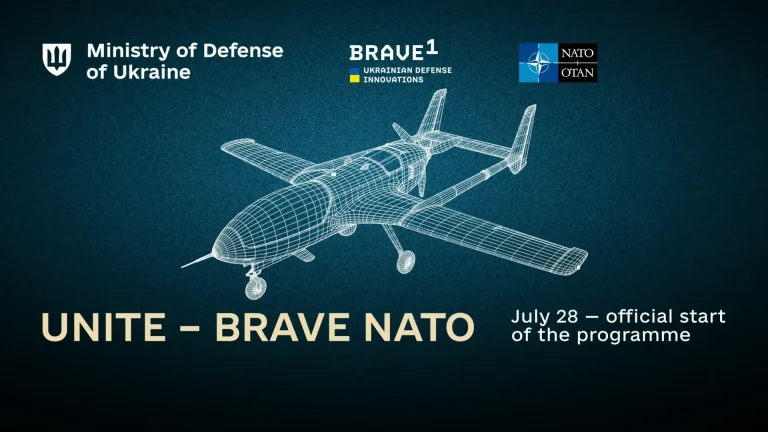
Britain’s pledge to provide Ukraine with 150,000 drones by the end of 2026 marks more than another allied support package. It shows frozen Russian sovereign assets moving from legal and financial pressure into the machinery of Ukraine’s war economy.
Reuters reported that the UK package is worth £752 million and will be funded through an Extraordinary Revenue Acceleration loan backed by proceeds from immobilised Russian sovereign assets. The UK Ministry of Defence has also confirmed the drone package, the delivery target and the use of ERA funding.
The number is striking. One hundred and fifty thousand drones would represent a substantial addition to Ukraine’s fast-expanding unmanned systems ecosystem. But the funding mechanism is the real strategic development. Western governments are increasingly moving from the principle that Russia should pay for the damage it has caused to practical systems that turn Russian asset proceeds into Ukrainian military supply.
Since the start of Russia’s full-scale invasion, Western governments have immobilised large volumes of Russian sovereign assets. For much of the war, the political argument focused on whether those assets could be seized outright, how far international law permitted their use, and whether such moves might undermine confidence in Western financial systems.
The ERA model takes a different route. Instead of directly confiscating the principal, allied governments use the extraordinary revenues generated by immobilised Russian assets to back loans for Ukraine. In practice, that allows proceeds from Russia-linked assets to support Ukrainian requirements without immediately resolving the more contentious question of full asset seizure.
The UK drone package shows what that can mean in military terms. Asset proceeds are no longer only a sanctions headline or a line in a fiscal-support package. They are becoming a procurement tool.
For Ukraine, that matters because drones are consumable at enormous scale. They are not prestige platforms delivered in small batches. They are battlefield inputs: reconnaissance drones, strike drones, interceptors, decoys and systems used for target acquisition, electronic adaptation and tactical pressure.
Ukraine’s war has made clear that drone capability is not measured only by sophistication. It is measured by volume, adaptation and replacement speed.
Small drones are lost daily to electronic warfare, air defence, weather, crashes and combat attrition. Successful units need constant resupply. New tactics often last only until the opponent adapts. Production must therefore be fast, distributed and responsive to front-line feedback.
A commitment to supply 150,000 drones by the end of 2026 should be understood in that context. It is not simply a headline number. It is an attempt to feed a battlefield system that consumes unmanned platforms at industrial scale.
The package also links drone supply to air-defence pressure. Ukraine is fighting a war in which drones are both offensive weapons and defensive tools. They are used to strike Russian logistics, identify artillery, intercept incoming threats and compensate for shortages in conventional ammunition. At the same time, Russia’s missile and drone attacks force Ukraine to spend scarce air-defence interceptors and constantly adapt its layered protection.
That makes the UK package part of a wider allied effort to sustain Ukraine’s ability to absorb Russian pressure while striking back at military and industrial targets.
The political symbolism is hard to miss. Russia’s own immobilised asset proceeds are being used to help fund weapons for the country Russia invaded.
For Moscow, that changes the sanctions equation. Asset freezes were initially about restricting access and signalling punishment. The ERA approach adds a further layer: the longer the war continues, the more Russia’s immobilised wealth can be tied to Ukraine’s ability to resist.
For Ukraine, the advantage is predictability. One of Kyiv’s recurring problems has been uncertainty over allied funding cycles, parliamentary delays and shifting political priorities. If ERA-backed funding can be converted into multi-year procurement lines, it gives Ukraine and its partners a clearer basis for production planning.
For allies, however, the model also creates obligations. Funding 150,000 drones is not the same as delivering them into units that can use them effectively. Procurement needs supply chains, testing, training, secure communications, electronic-warfare adaptation, batteries, spares and maintenance. It also requires a production base capable of keeping pace with front-line changes.
The UK package is also an industrial signal. Britain has been trying to position itself as a leading European supporter of Ukraine while strengthening its own defence-industrial role. Drone production offers a relatively fast way to connect support for Kyiv with domestic and allied manufacturing capacity.
That does not remove the scale problem. Ukraine’s own defence industry has become highly innovative under wartime pressure, but European partners still need to increase output, simplify procurement and accept that unmanned systems evolve faster than traditional acquisition cycles.
Defence Matters has recently examined how Russia’s mass strikes on Ukraine renew questions over NATO border air defence. This package adds a financial dimension to that story. The question is no longer only what Ukraine needs, but how those needs can be funded at scale when traditional aid budgets are politically strained.
ERA-backed funding may become one answer. If it works, other allies may be pushed to convert frozen-asset revenues into more concrete procurement pipelines: drones, air-defence missiles, artillery ammunition, electronic-warfare systems and industrial expansion.
The UK’s drone package does not solve Ukraine’s battlefield supply problem by itself. Russia is producing and importing drones at huge scale, adapting electronic-warfare tactics and sustaining long-range strike campaigns against Ukrainian cities, energy infrastructure and military targets.
But the package does set an important precedent. It shows how sanctions, finance and defence procurement are beginning to merge.
Frozen Russian assets were once treated mainly as a legal and diplomatic issue. They are now becoming part of the material architecture of Ukraine’s defence. If the UK delivers the promised drones on schedule, the package will demonstrate that immobilised Russian wealth can be turned into recurring battlefield supply rather than symbolic punishment alone.
That is why the announcement matters. The drones are the visible output. The deeper shift is that Western sanctions policy is moving into Ukraine’s war economy one procurement package at a time.